

Trade tensions, shifts in political priorities, and the accelerating demand for green solutions have been reshaping global capital flows and opening new avenues for cross-border investments. Against this backdrop, investors from Nordic countries—spanning Denmark, Finland, Iceland, Norway, and Sweden—have increasingly looked to Latin America1 as a destination for projects requiring long-term deployment of capital.
In fact, following negotiations that began in 1999 and were relaunched in 2016, the European Union ("EU") and the founding members of the Southern Common Market ("Mercosur"), now comprising Argentina, Brazil, Paraguay and Uruguay, reached a political agreement in December 2024 and signed the EU-Mercosur Partnership Agreement—which includes Denmark, Sweden and Finland as EU Member States—in January of 2026. These developments, unfolding against the backdrop of rising U.S.-European geopolitical tensions, indicate that trade liberalization and investment facilities between Europe, including the Nordic region, and Latin America are set to deepen.2
The steady growth of this investment corridor reflects a strong alignment between Latin America's abundant natural resources, expanding consumer markets, and the ESG-forward posture of certain jurisdictions, on the one hand, and the Nordic region's decades of experience in clean energy, advanced technology, and sustainability-driven innovation, on the other. This note discusses this investment trend in more detail, identifies potential risks that could impact existing or future investments in key Latin American jurisdictions, and previews various legal strategies that could be implemented to guarantee the legal protection of those long-term investments.
Key Trends in Nordic-Latin America Investments
Over recent years, Nordic investors have been making diversified and long-term investments into several sectors across Latin America. For example:
- In the energy sector, Nordic investors have recently deployed substantial capital for the development of renewable generation assets and system-modernization initiatives across the region. For example, Norwegian, Finish, and Danish energy companies have recently acquired and expanded renewable energy portfolios in Brazil3 and Chile,4 where Norwegian firms have also reportedly been developing green hydrogen and ammonia projects.5 Meanwhile, leading Swedish firms have been supporting the modernization and rehabilitation of large hydroelectric assets in Peru and Colombia.6 Nordic firms have further been supporting transmission enhancements, storage pilots, and advanced engineering services to strengthen local power systems across the region.7
- In the industrial technology and digital infrastructure sectors, Nordic investors have supported the modernization of manufacturing platforms, logistics systems, and connectivity networks across Latin America. This includes the expansion of automation and process-engineering capabilities, as well as manufacturing and distribution capabilities through acquisitions of existing operations in Argentina,8 Brazil,9 Chile10 and Mexico.11 Nordic capital is also supporting the development of data centers and fiber-optic capacity in key urban hubs12 and providing cybersecurity and telecom solutions.
- Additionally, Nordic expertise and capital have supported major maintenance, reliability and automation initiatives in the mining sector, particularly in Brazil, Chile, Ecuador, Mexico, and Peru, contributing to improved efficiency and sustainable innovation.13
- In other sectors, Nordic investments have focused on high-value platforms that promote technological adoption and enhance operational performance. For example, a leading Swedish firm has led the expansion of virtual care and diagnostics networks in Brazil,14 Colombia;15 and Mexico,16 while Nordic funds have been financing large-scale water treatment and recycling facilities.17 As another example, Nordic capital has also played a significant role in the development of aquaculture infrastructure in Chile18 and Colombia.19
The rapid expansion of Nordic investments into Latin America has been possible due to the region's vast natural resources, growing consumer markets, and increased ESG-aligned policy priorities that intersect with Nordic countries' strengths in clean energy, technology, and sustainability-driven innovation. This alignment has opened and will likely continue to open opportunities as Latin American governments and private counterparts are seeking partners capable of accelerating decarbonization, modernizing infrastructure, and deploying resource-efficient solutions.
Legal and Regulatory Risks for Nordic Investors in Latin America
These investment opportunities and synergies do not come risk free. Given the heavily regulated nature of the sectors in which they have focused, Nordic investments face a unique set of risks that could impact their long-term sustainability and economics. To note a few examples, as summarized below, certain jurisdictions have implemented policy shifts and regulatory actions that could affect the stability of long-term concessions, tariff structures, permitting timelines, and contractual protections that could be central to operating models and profitability assumptions.
Some specific jurisdiction risks and recent events include:
- In Argentina, the Javier Milei administration's sweeping liberalization agenda has created openings for Nordic companies in industrial technology, digital infrastructure, and energy, but the speed and breadth of the changes has also introduced regulatory and implementation uncertainty.20 Macroeconomic volatility,21 evolving subsidy frameworks,22 shifting capital and profit repatriation rules,23 as well as social licensing/labor risks could materially impact new and existing long-term investments.24
- In Brazil, regulatory complexity remains the central challenge for investors across various industries. For example, the 2023 tax reform's multi year transition (beginning in 2026) across federal, state, and municipal levels will require navigating evolving rules on tax classification, credit recoverability, effective rates, and reassessments that could disrupt pricing, indexation, and long term contract economics for multi state platforms.25 This risk is particularly acute for investors with long-term concessions, PPAs/offtake structures, and inflation-indexed formulas. Brazil is also currently rebalancing public procurement and concession regimes (often state specific) and introducing more robust local content and ESG-related compliance requirements, which could delay projects, prompt contractual renegotiations, and/or increase State scrutiny.
- In Colombia, heightened policy volatility under the Gustavo Petro administration has been reshaping risk assessments for investors in power, transmission, and resource management projects, particularly with respect to tax, and environmental regulations. These changes, together with permitting and interconnection bottlenecks, could increase operational and logistics risks for project delivery.26 In renewables specifically, regulatory shifts affecting incentives and project economics have contributed to greater investor uncertainty and slower investment momentum. Uncertainty remains in light of upcoming presidential elections.
- In Chile, despite macroeconomic stability, prolonged permitting timelines and administrative bottlenecks have continued to hinder long term energy, transmission, storage, and water treatment projects.27 For Nordic investors in renewables, grid congestion, curtailment risk, and delays in interconnection approvals remain critical bankability concerns. While a new administration presided by José Antonio Kast will take office in March, uncertainty remains. Nearing the conclusion of President Gabriel Boric's government, the country's bureaucratic delays remain a key friction point.
- In Mexico, Nordic investors face a unique risk profile as a sharp turn toward greater State control in various sectors, including energy, has impacted market dynamics. For example, measures seeking to strengthen State-owned entities, Petróleos Mexicanos ("Pemex") and the Comisión Federal de Electricidad ("CFE"), have limited private participation and affected renewable energy developers and grid services providers. Regulatory discretion and shifting administrative criteria (including permitting and dispatch priorities) also continue to be key risks for project timelines and operating stability. Additionally, the ongoing judicial reform requiring the popular election of judges has raised rule-of-law concerns and increased unpredictability as to the availability and effectiveness of judicial relief in investment and administrative disputes. This may increase enforcement risk and reduce confidence in interim relief mechanisms, which had previously benefited some energy investors.
- Finally, in Peru, persistent power market volatility and the potential for misinterpretation of tax rules can destabilize tariffs, pricing, and long term project economics. Permitting delays that exceed statutory timelines, evolving environmental review rules, and the financial distress of certain State-owned entities have elevated execution and counterparty risks.28 Investors should also consider the likelihood of project slowdowns from social conflict dynamics and the practical challenges of land access/community engagement in resource-adjacent infrastructure corridors.
It is thus essential that Nordic investors plan for a dynamic risk environment that is commonly shaped by both electoral cycles, fluctuations in commodity prices, and more increasingly, external geopolitical pressures.
Navigating Legal and Regulatory Risks for Nordic Investors in Latin America
To mitigate these risks, Nordic investors should ensure they are protected against policy shifts and any State measures that could devalue or interfere with their assets or relationships with private counterparts.
In transactions with private counterparts and State agencies, Nordic investors should ensure that their contracts contain carefully drafted governing law and arbitration clauses to ensure, when possible, that the parties' relationship is governed by more stable principles and that any dispute can be resolved in a neutral forum. While the specific risk and the scope of arbitrable matters vary by jurisdiction, it is generally advisable to avoid exposure to proceedings before national courts. In contracts with State agencies, investors can also incorporate contractual safeguards that provide early remedies or exit rights if conditions deteriorate. This includes, for example, stabilization and change-in-law clauses, sovereign immunity provisions in State contracts, as well as termination rights tied to specific regulatory events, and renegotiation triggers.
Nordic investors should also verify whether their investments benefit from protections afforded by an expansive web of international investment treaties that Latin American jurisdictions have signed to attract and promote foreign investments. Provided certain jurisdictional conditions are met, these treaties typically offer a range of substantive protections, such as guarantees of fair and equitable treatment ("FET") and full protection and security ("FPS"), protections against direct or indirect expropriation without compensation, promises of non-discrimination (through national treatment and most favored nation ("MFN") treatment), guarantees regarding the free transfer abroad of profits, an obligation on the part of the State (or its entities) to respect contracts entered into with investors (the so-called "umbrella clause"). Importantly, most of these treaties allow the investor to bring a direct claim against the host State for any such breach before the International Centre for Settlement of Investment Disputes (ICSID), a branch of the World Bank that provides significant enforcement benefits, as well as other institutions.
The below table maps the Nordic–Latin America investment treaty landscape, highlighting where international investment treaties exist and, crucially, where they include investor–state dispute settlement (ISDS). A blue check signals pairings that meet both criteria; a gray cross indicates where both are absent.
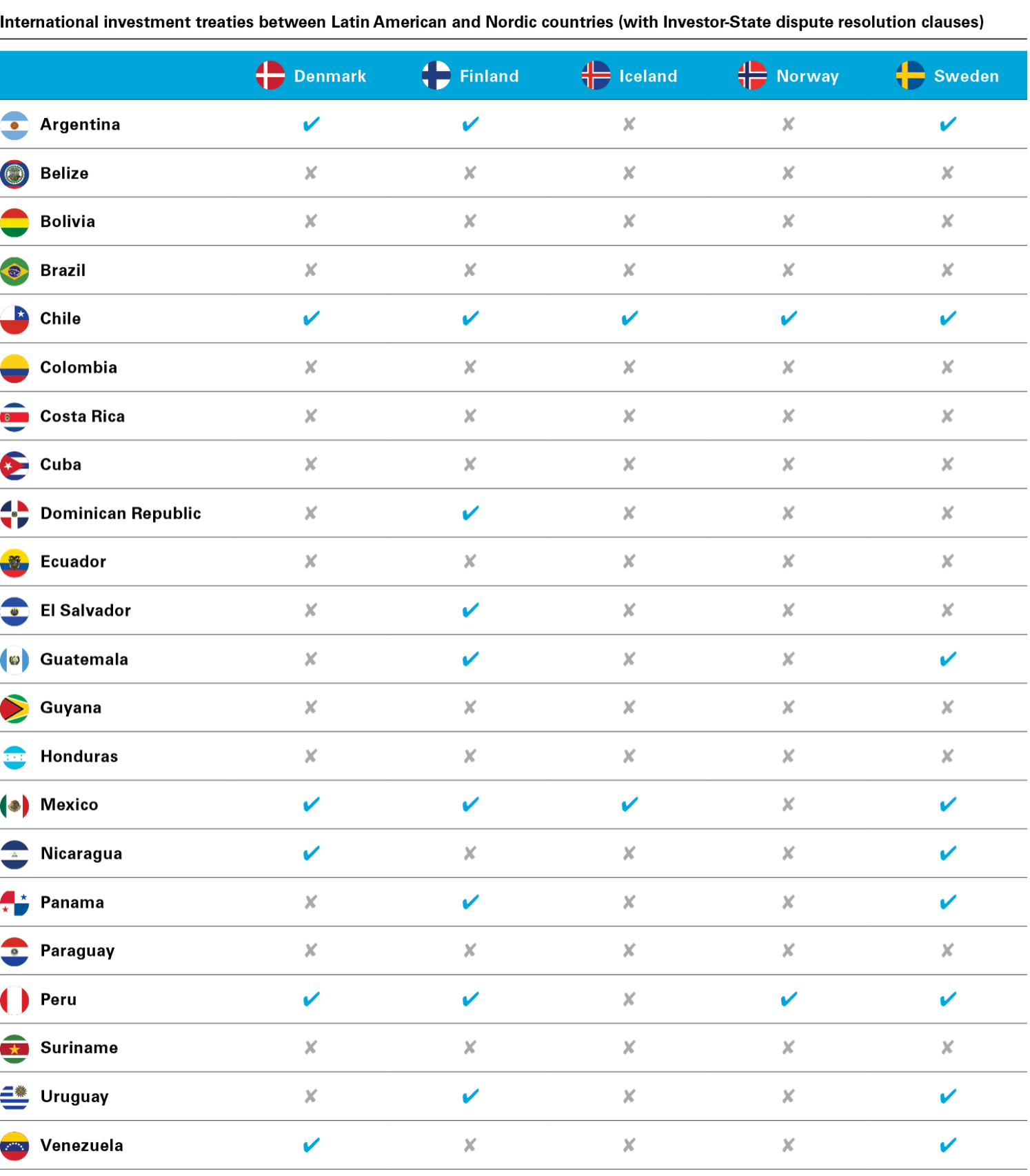 View full image: International investment treaties between Latin America and Nordic countries (with Investor-State dispute resolution clauses)
As the table shows, existing ISDS coverage for Nordic investors in Latin America remains uneven.29 Even within treaties that provide ISDS, there can be significant variations between them, such as carve-outs for national security and taxation, that can materially affect both the scope of substantive protections and practical access to ISDS.
Of note, even if the country of origin (e.g., Norway) does not have a treaty in place with a particular country (e.g., Argentina), it would be possible for investors to structure their investments in such a way as to benefit from an existing treaty (e.g., by routing the investment through a holding company in a protected jurisdiction). It is, however, essential that coverage be assessed by specialized international counsel.
It is also highly advisable that investors implement or review their anti-corruption compliance strategies to avoid enforcement risk and ensure the continued availability of legal protections.
***
In sum, Nordic capital is well positioned to align with Latin America's energy transition, infrastructure expansion, and technology agendas, but the preservation of value in 2026 and beyond will largely hinge on preparing for policy shifts, including by embedding robust legal protections.
Paula Ibargüen Ponce (White & Case, International Arbitration Fellow, Miami) contributed to the drafting of this publication.
1 For the purposes of this article, references to "Latin America" include Mexico, all Central American and South American countries, as well as Cuba and the Dominican Republic.
2 The EU and Mercosur sign historic and ambitious partnership, EUROPEAN COMMISSION dated January 16, 2026 available on: https://ec.europa.eu/commission/presscorner/detail/en/ip_26_113.
3 See, e.g., Norwegian Consulate General Rio de Janeiro releases Investment Report: Norwegian Value Creation in Brazil 2021–2022, 2023 Edition dated 2023 available at https://www.norway.no/contentassets/070c71bcc5ed45edbabe823533cdbe30/norwegian-investment-report-2023---english.pdf.
4 See, e.g., Statkraft reports Financial Results for Q1 2025, STATKRAFT dated May 8, 2025 available at https://ml-eu.globenewswire.com/Resource/Download/d4c61f70-661c-443f-8e07-12671e403b1a.
5 See, e.g., Aker Horizons and Statkraft Partnering to Explore Green Hydrogen and Ammonia Opportunities in India and Brazil, AKER HORIZONS NEWS ROOM, dated April 26, 2022, available at: https://akerhorizons.com/news/aker-horizons-and-statkraft-partnering-to-explore-green-hydrogen-and-ammonia-opportunities-in-india-and-brazil/; Mainstream and Aker Clean Hydrogen to collaborate on green hydrogen and low-cost ammonia in Chile, MAINSTREAM RENEWABLE POWER NEWSROOM dated February 19, 2021 available at https://www.mainstreamrp.com/news/mainstream-and-aker-clean-hydrogen-to-collaborate-on-green-hydrogen-and-low-cost-ammonia-in-chile/.
6 See, e.g., AFRY supervises the modernisation of Peru's largest hydro power plants, AFRY NEWSROOM dated December 12, 2024 available at https://afry.com/en/newsroom/press-releases/afry-supervises-modernisation-perus-largest-hydro-power-plants; Swedfund partners on rehabilitation and optimization of hydropower in Colombia, SWEDFUND dated April 1, 2025 available at https://www.swedfund.se/en/investments-and-projects/rehabilitation-and-optimisation-of-hydropower-in-colombia.
7 Statkraft strengthens core activities and competitiveness following strategic review, STATKRAFT NEWS ROOM dated June 18, 2025 available at https://www.statkraft.com/newsroom/news-and-stories/2025/statkraft-strengthens-core-activities-and-competitiveness-following-strategic-review/.
8 Atlas Copco has acquired an Argentinian compressed air distributor, ATLAS COPCO NEWSROOM, dated April 4, 2023, available at https://www.atlascopcogroup.com/en/media/press-releases/2023/20230404-asven-acquisition.
9 Brazilian compressed air manufacturer has become part of Atlas Copco Group, ATLAS COPCO NEWSROOM, dated December 3, 2024, available at https://www.atlascopcogroup.com/en/media/press-releases/2024/20241203-Metalplan.
10 Atlas Copco wins order from Pucobre in Chile to strengthen mining productivity, ATLAS COPCO NEWSROOM, dated March 7, 2018, available at https://www.atlascopcogroup.com/en/media/press-releases/2018/20180307-order-in-chile.
11 Vacuum distributor in Mexico to become part of Atlas Copco Group, ATLAS COPCO NEWSROOM, dated April 4, 2024, available at https://www.atlascopcogroup.com/en/media/press-releases/2024/20240404-meisa.
12 Finnfund and IDB Invest partner with Netwey to expand internet access in Mexico, FINNFUND, dated April 4, 2025 available at https://www.finnfund.fi/en/news-and-publications/news/finnfund-and-idb-invest-partner-with-netwey-to-expand-internet-access-in-mexico/.
13 Atlas Copco wins order from Pucobre in Chile to strengthen mining productivity, ATLAS COPCO NEWSROOM dated March 7, 2018 available at https://www.atlascopcogroup.com/en/media/press-releases/2018/20180307-order-in-chile; Mining Finland and LinkMiners announce partnership to bring Finnish technology to Latin America, MINING FINLAND dated June 8, 2022 available at https://miningfinland.com/blog/mining-finland-and-linkminers-partnership. In Mining, Finland Literally Rocks – and Latin America is Booming, MEXICOBUSINESSNEWS dated June 10, 2025 available at https://mexicobusiness.news/mining/news/mining-finland-literally-rocks-and-latin-america-booming.
14 Cardo Health raises USD 17.5 million to take digital health to emerging markets, CARDO HEALTH NEWSROOM dated 11 January 11, 2022, available at https://news.cision.com/cardo-health/r/cardo-health-raises-usd-17-5-million-to-take-digital-health-to-emerging-markets,c3483788.
15 Cardo Health expands to Mexico with MIT Media Lab social impact spinoff, CARDO HEALTH NEWSROOM dated July 7, 2022 available at https://news.cision.com/cardo-health/r/cardo-health-expands-to-mexico-with-mit-media-lab-social-impact-spinoff,c3598178.
16 Colombian healthtech doc-doc receives $1M investment from Cardo Health, LATAMLIST dated August 31, 2022, available at https://latamlist.com/colombian-healthtech-doc-doc-receives-1m-investment-from-cardo-health/.
17 Climate Investor Two delivering climate and social value to critical sectors, NORDIC DEVELOPMENT FUND, dated January 24, 2022 available at https://www.ndf.int/newsroom/climate-investor-two-delivering-climate-and-social-value-to-critical-sectors.
18 Mowi Chile – Sustainability in Chile, MOWI, available at https://mowi.com/fo/contact/mowi-chile/. See also Norwegian Alotta to supply renewable energy to Mowi Chile, Weareaquaculture, dated October 2, 2025, available at https://weareaquaculture.com/news/technology/norwegian-alotta-to-supply-renewable-energy-to-mowi-chile.
19 Joint venture to supply genetically improved tilapia in Colombia, GENOMAR NEWSROOM dated October 25, 2021 available at https://genomar.com/2021/10/25/genomar-and-sanmarino-announce-a-joint-venture-to-supply-genetically-improved-tilapia-in-colombia/.
20 Argentina sharply devalues its currency and cuts subsidies as part of shock economic measures, ASSOCIATED PRESS dated December 12, 2023 available at https://apnews.com/article/argentina-economy-dollar-devaluation-economy-cuts-28089d64ae72bde12d53be59b5bc5a85; Argentina Eliminates Capital Controls and Payment Timelines, INTERNATIONAL TRADE ADMINISTRATION dated April 23,2025 available at https://www.trade.gov/market-intelligence/argentina-eliminates-capital-controls-and-payment-timelines; Financial Liberalization: Benefits, Risks and Country Experiences, WORLD BANK, dated September 19, 2019 available at https://documents1.worldbank.org/curated/en/099105006102227360/pdf/P1647370e55f1b0b0995e0753b806d05fd.pdf.
21 IMF urges ‘concerted effort' from Argentina to rebuild its international reserves, BUENOS AIRES HERALD, dated December 5, 2025 available at https://buenosairesherald.com/economics/imf-urges-concerted-effort-from-argentina-to-rebuild-its-international-reserves. OECD Economic Surveys: Argentina 2025, OECD, dated July 7, 2025 available at https://www.oecd.org/en/publications/oecd-economic-surveys-argentina-2025_27dd6e27-en.html. Argentina Country Report, ALLIANZ, dated January 2026 available at https://www.allianz-trade.com/en_global/economic-research/country-reports/Argentina.html.
22 Argentina enacts Bases Law and Tax Package, EY GLOBAL dated July 8, 2024 available at https://www.ey.com/en_gl/technical/tax-alerts/argentina-enacts-bases-law-and-tax-package.
23 IMF urges ‘concerted effort' from Argentina to rebuild its international reserves, BUENOS AIRES HERALD, dated December 5, 2025 available at https://buenosairesherald.com/economics/imf-urges-concerted-effort-from-argentina-to-rebuild-its-international-reserves.
24 Milei files bill to change law protecting glacier areas to promote mining, BUENOS AIRES HERALD, dated December 16, 2025 available at https://buenosairesherald.com/business/milei-files-bill-to-change-law-protecting-glacier-areas-to-promote-mining. Argentina's unions threaten strike during march against labor reform, BUENOS AIRES HERALD, dated December 18, 2025 available at https://buenosairesherald.com/politics/argentinas-unions-threaten-strike-during-march-against-labor-reform.
25 Brazilian Government announces substantial tax changes affecting Interest on Net Equity, financial investments, betting operations and IOF regulations, EY GLOBAL, dated June 12, 2025 available at https://www.ey.com/en_gl/technical/tax-alerts/brazilian-government-announces-substantial-tax-changes-affecting-interest-on-net-equity-financial-investments-betting-operations-and-iof-regulations; Brazil tax reform 2025: How corporate professionals are embracing practical change, THOMSON REUTERS dated October 14, 2025 available at https://www.thomsonreuters.com/en-us/posts/corporates/brazil-tax-reform-2025-corporate-professionals/.
26 Macro-Fiscal Impacts of Colombia's Energy Transition Plan, IMF ELIBRARY, dated November 25, 2025 available at https://www.elibrary.imf.org/view/journals/018/2025/145/article-A001-en.xml. Colombia's renewables grow, but gap looms, ARGUS dated April 7, 2025 available at https://www.argusmedia.com/en/news-and-insights/latest-market-news/2675727-colombia-s-renewables-grow-but-gap-looms.
27 OECD Economic Surveys: Chile 2025, OECD dated January 15, 2025 available at https://www.oecd.org/en/publications/oecd-economic-surveys-chile-2025_efad96ce-en.html.
28 Peru lawmakers advance mining permit extension after protests, REUTERS, dated November 18, 2025 available at https://www.reuters.com/sustainability/perus-informal-miners-protest-congress-against-ending-temporary-permits-2025-11-18/.
29 Bolivia previously maintained BITs with Sweden and Denmark, both of which were terminated following Bolivia's unilateral denunciation. Each treaty provided for investor–state dispute settlement (ISDS) and contained a sunset clause -a provision that preserves treaty protection and access to ISDS for investments made before termination for the specific post-termination period. In particular, the Bolivia-Sweden BIT was terminated on 4 July 2013, but had a 20-year sunset clause. Ecuador similarly terminated its BITs with Finland and Sweden, both of which provided for ISDS and included sunset clauses. In the case of the Sweden-Ecuador BIT, it was terminated on 18 May 2018, but it had a 15-year sunset clause.
White & Case means the international legal practice comprising White & Case LLP, a New York State registered limited liability partnership, White & Case LLP, a limited liability partnership incorporated under English law and all other affiliated partnerships, companies and entities.
This article is prepared for the general information of interested persons. It is not, and does not attempt to be, comprehensive in nature. Due to the general nature of its content, it should not be regarded as legal advice.
© 2026 White & Case LLP


