

Highly Expedited Arbitration under the ICC Rules 2026: A potential new tool to enforce Dispute Adjudication Board decisions?
9 min read
The new International Chamber of Commerce ("ICC") Arbitration Rules came into effect on June 1, 2026. As reported in our previous alert, a key change made as part of the update was the introduction of a new Highly Expedited Arbitration procedure. In this alert, we consider whether Highly Expedited Arbitration could offer a viable way for parties on construction projects to enforce dispute adjudication board ("DAB") decisions quickly and efficiently.
What are DABs?
DABs are most commonly utilized on large, international construction projects. When a dispute arises, a DAB produces a decision within a relatively short timeframe (invariably much faster than would be achieved in arbitration or litigation) and in a way which is generally considered to be cost-effective.1 The DAB process is a creation of the contract, most notably found in the suite of contracts published by the International Federation of Consulting Engineers/Fédération Internationale des Ingénieurs-Conseils ("FIDIC").2
Under the FIDIC forms, a distinction is made between DAB decisions that are final and binding and those that are binding but not final. A decision becomes final and binding if no notice of dissatisfaction is given within the contractually prescribed period, in which case the decision is not subject to further substantive review. If a party does give a timely notice of dissatisfaction, the decision is binding but not final, and the underlying dispute may be escalated in accordance with the contract's dispute resolution provisions, normally toward arbitration proceedings.
In both cases, a key feature of a DAB's decision is that it is immediately binding on the parties and must be promptly complied with. In the case of a binding but not final decision, the decision remains binding until it is overturned by agreement or arbitration/litigation (if indeed it ever is). This feature is particularly important for contractors who are often on the receiving end of payment-related decisions. Employers' prompt compliance with DAB decisions awarding amounts to contractors is vital, as it allows contractors to maintain their cash flow position.
Data published by King's College London in 20243 shed some light on compliance with DAB decisions in practice. When asked how often parties complied with binding decisions, the responses were as follows:4
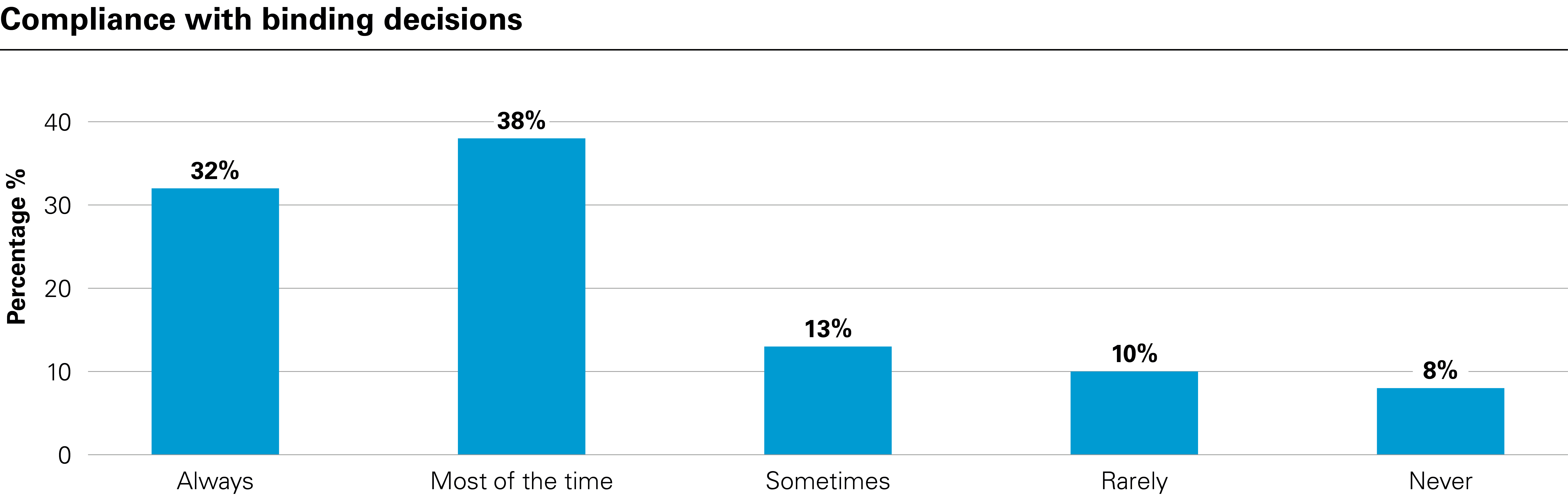
Notably, compliance with binding DAB decisions does not appear to be much better than compliance with non-binding dispute board recommendations,5 for which the respective responses were as follows:6
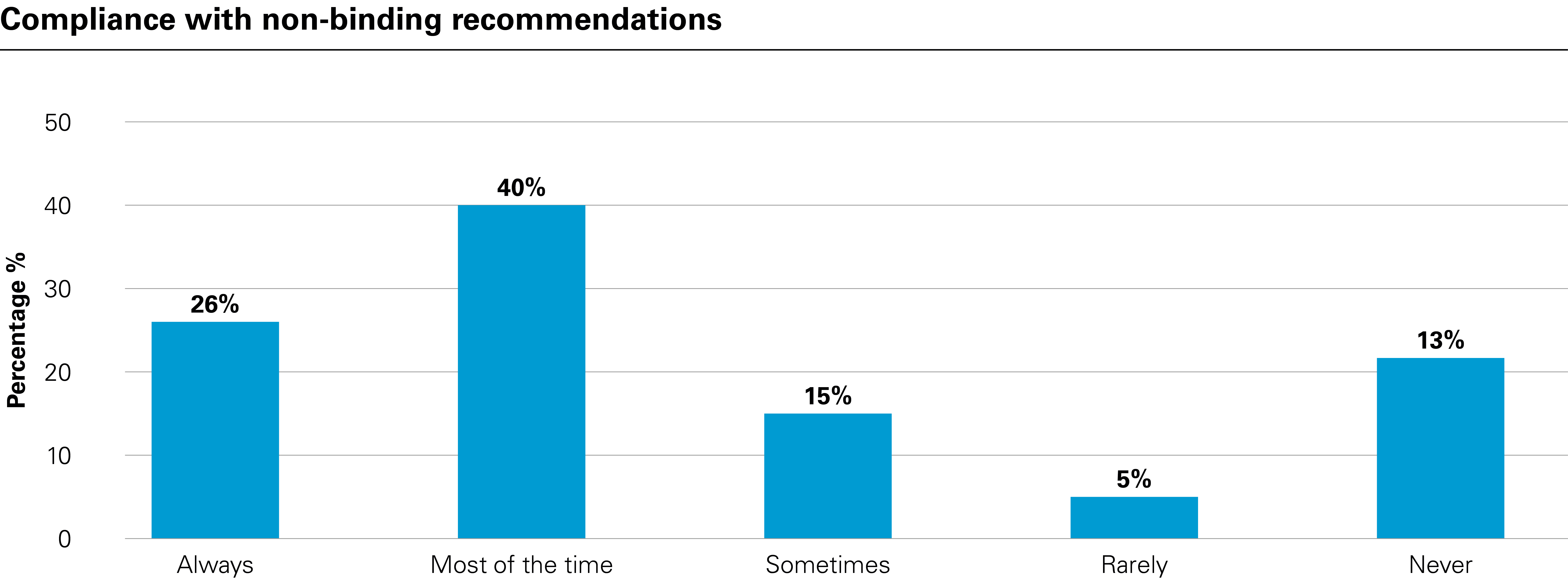
Thus, although it appears, based on this survey, that DAB decisions are complied with more often than dispute resolution practitioners may expect, there remains a clear need for a prompt and effective enforcement mechanism in case a party fails to comply with such a decision.
The 2017 FIDIC contracts, as amended in 2022, provide that where a party fails to comply with a DAB decision, whether binding or final and binding, the other party may refer the failure itself to arbitration in accordance with the contract's arbitration clause, which provides for arbitration under the ICC Rules.7 Importantly, it is the failure to comply which is referred to arbitration in this situation (sometimes referred to as "compliance arbitration"), not the underlying dispute which was considered by the DAB.
In recent years, following the introduction of (non-highly) expedited arbitration procedures in various arbitration rules, there have been suggestions that expedited arbitration could be used to enforce DAB decisions. For example, in 2017 the ICC introduced its Expedited Procedure,8 which requires an award to be rendered within six months of the initial Case Management Conference, subject to any extension.9 The Expedited Procedure, as amended in 2026, applies where the amount in dispute does not exceed US$4 million,10 unless the parties agree to opt out or the ICC International Court of Arbitration ("ICC Court") determines the Expedited Procedure is inappropriate to use.11 Parties can also agree to use the Expedited Procedure regardless of value. However, concerns have been raised that a six-month timeframe might still be too long a period for the enforcement of a DAB decision.12
The benefits of Highly Expedited Arbitration
As its name indicates, Highly Expedited Arbitration provides for an arbitral award within an even shorter timeframe than the ICC's Expedited Procedure: three months from the initial Case Management Conference,13 compared to six months under the Expedited Procedure14 and an average duration of 24 months for "regular" ICC arbitration proceedings.15 To achieve this, the Highly Expedited Arbitration procedure provides that:
- Disputes are decided by a sole arbitrator.16
- Submissions are front-loaded.17
- A Case Management Conference takes place within seven days of the tribunal receiving the file from the Secretariat.18
- The respondent must submit its Answer and Statement of Defense within 30 days of receipt of the claimant's Request and Statement of Claim.19
- The tribunal may decide the dispute on a documents-only basis.20
In most cases the above features would seem appropriate where a party was seeking to enforce a DAB decision. As noted, the failure to comply with the decision would be what was referred to arbitration, and not the substance of the underlying dispute considered by the DAB.
A faster and simplified process would likely also result in more cost-effective proceedings, in particular where there is no hearing. Indeed, the minimum and maximum arbitrator fee scales are slightly lower than for regular ICC arbitration.21
Obstacles to the application of Highly Expedited Arbitration
The main hurdle to application of the Highly Expedited Arbitration procedure is that both parties must specifically consent to it. This can be contrasted with the ICC's (non-highly) Expedited Procedure, which, as noted above, will apply by way of default to disputes under a certain monetary threshold. The parties can agree to use Highly Expedited Arbitration regardless of the amount in dispute, which is important as a DAB's decision may be for a significant sum on a large construction project.
After a DAB has given its decision, consent to use Highly Expedited Arbitration is unlikely to be forthcoming from the party that was unsuccessful in the DAB proceedings and refuses to comply with its decision. However, consent to use Highly Expedited Arbitration could be expressly set out in the dispute resolution provisions of the contract between the parties; the ICC's guidance note confirms that consent could be contained in an arbitration agreement.22
However, even where both parties have consented to the use of Highly Expedited Arbitration, it is possible for the procedure to be disapplied by the ICC Court at the request of a party or the tribunal, or on the ICC Court's own motion.23 As such, there is potential for the party resisting enforcement to make such a request in an attempt to disrupt, or even thwart, the use of Highly Expedited Arbitration to enforce a DAB decision. Given the novelty of the mechanism, it is not yet known how the ICC Court would respond to such attempts. The undersigned are of the view that the ICC Court would be highly unlikely to disapply a well-drafted clause expressly providing for the parties' agreement that any DAB decision may be enforced by way of Highly Expedited Arbitration.
Alternatives?
The ICC is not the first institution to introduce a highly expedited procedure into its rules. For example, the 2025 update to the Singapore International Arbitration Centre's rules saw the introduction of a "Streamlined Procedure" which similarly provides for an award within three months from the constitution of the tribunal.24 Further, the Expedited Arbitration Rules 2023 of the Stockholm Chamber of Commerce require an award to be made within three months of the date the case was referred to the tribunal.25
Another option could be to agree a period for the rendering of the award in the arbitration agreement. For example, UNCITRAL's model adjudication clause expressly provides that any dispute concerning compliance with the adjudicator's determination may be referred to arbitration in accordance with the UNCITRAL Expedited Arbitration Rules.26 Those Rules normally require an award to be made within six months of the tribunal's constitution,27 but the model clause includes express provision for this to be shortened (30 days is suggested) and to limit the maximum extended period (60 days is suggested).28 However, the extent to which this is permissible may depend on matters such as the lex arbitri or arbitral rules.
Conclusion
Due to the requirement for the parties' express consent to its application, the new ICC Highly Expedited Arbitration procedure will be of little practical benefit for parties to existing contracts based on the FIDIC forms, as a party on the losing side of a DAB decision is unlikely to agree to its use.
Nevertheless, contracting parties may consider adopting this new procedure in their future contracts, for the purpose of enforcing DAB decisions, by introducing appropriate amendments to their contractual terms.
1 2025 International Arbitration Survey – The path forward: Realities and Opportunities in Arbitration (White & Case and Queen Mary University of London), p. 6.
2 In the FIDIC suite of contracts, the DAB was first introduced in the FIDIC Conditions for Design-Build and Turnkey (1995), also known as the FIDIC Orange Book, and was then adopted in subsequent editions of the FIDIC books, including in the 1999 FIDIC forms of contract for major works, which are still widely used. The DAB was renamed the "Dispute Avoidance/Adjudication Board" in the 2017 suite due to the additional dispute avoidance role played by the board.
3 2024 Dispute Board International Survey: A Study on the Worldwide Use of Dispute Boards over the Past Six Years (Nazzini and Moreira).
4 Page 53, figure 62. The data show individuals who responded; for entities, the experience was similar (figure 63).
5 Sometimes referred to as "dispute review boards," and used as an alternative to DABs, mostly in the US.
6 Page 52, figure 60. The data show individuals who responded.
7 Sub-Clause 21.7 [Failure to Comply with DAAB's Decision] of the 2017 FIDIC books, as amended in 2022.
8 Now set out in Appendix V of the ICC Arbitration Rules 2026.
9 Appendix V, Art. 4.
10 For arbitration agreements concluded on or after June 1, 2026.
11 Appendix V, Art. 1.
12 Proposal for Enforcement of Agreements of the Parties, Final And Binding Determinations of the Engineer and Decisions of the DAAB Under FIDIC's 2017 Rainbow Suite (as Amended in 2022) ICLR 106 (Seppälä).
13 Appendix VI, Art. 7(1), subject to any extension.
14 Appendix V, Art. 4, subject to any extension.
15 ICC Dispute Resolution Statistics: 2024, p. 15.
16 Appendix VI, Art. 4.
17 Appendix VI, Art. 2, e.g. the Claimant must include its Statement of Claim with its Request, and the Respondent must provide its Statement of Defense (and Statement of Counterclaim, if any) with its Answer.
18 Appendix VI, Art. 6.1.
19 Appendix VI, Art. 2.5.
20 Appendix VI, Art. 6.3.
21 Schedule of Fees, Art. 6.2.
22 Note to Parties and Arbitral Tribunals on the Conduct of ICC Arbitration 2026, para. 129.
23 Appendix VI, Art 1.2.b.
24 Schedule 2, Art. 15.
25 Art. 43, subject to any extension.
26 Art. 3.
27 Art. 16, subject to any agreement otherwise or extension.
28 Arts. 3(c) and (d).
White & Case means the international legal practice comprising White & Case LLP, a New York State registered limited liability partnership, White & Case LLP, a limited liability partnership incorporated under English law and all other affiliated partnerships, companies and entities.
This article is prepared for the general information of interested persons. It is not, and does not attempt to be, comprehensive in nature. Due to the general nature of its content, it should not be regarded as legal advice.
© 2026 White & Case LLP


