

The NSIA Annual Report
The latest National Security and Investment Act 2021 (NSIA) Annual Report (the NSIA Report) has now been published, providing an overview of the regime's operations from April 2025 to March 2026 (the NSIA Report Period). That overview includes statistics on clearances, timeframes, sectoral focus, and investor origin, thus providing valuable insights into the regime's process and priorities as they continue to evolve.
The NSIA Report also coincides with the installation of a new decision-maker at the helm in the Cabinet Office, with former Transport Secretary Louise Haigh announced as the new Minister for the Cabinet Office and Chancellor of the Duchy of Lancaster on 20 July 2026.
The NSIA Report in Numbers
Notifications
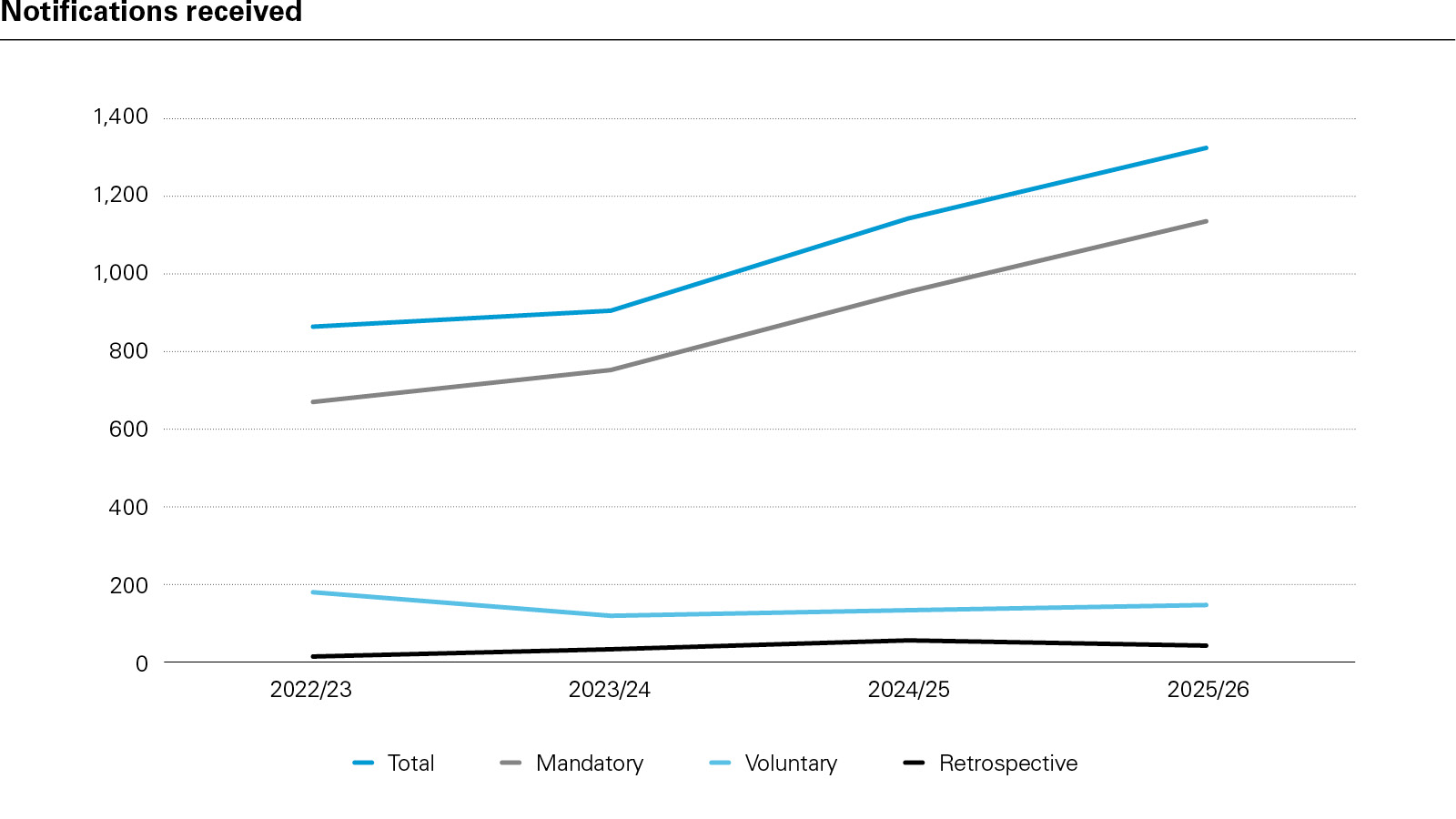
During the fourth full year of the NSIA's operations, the Investment Security Unit (ISU) in the Cabinet Office received 1,324 notifications. This is an increase from the 1,143 notifications that the government reported from the previous period.1
There are three kinds of notification under the NSIA and all saw an increase in the period between 1 April 2025 and 31 March 2026 covered by the NSIA Report Period, compared to the preceding twelve months.
- Mandatory Notifications are submitted in respect of qualifying acquisitions in targets that perform certain specified activities in a 'sensitive sector' in the UK, as defined by the National Security and Investment Act 2021 (Notifiable Acquisition) (Specification of Qualifying Entities) Regulations 2021 (the NSIA Regulations). These notifications are suspensory – closing cannot take place until the notified acquisition is cleared. During the NSIA Report Period the ISU received 1,135 mandatory notifications – an increase of nearly 200 mandatory notifications on the 2024/25 period.
- Voluntary Notifications are typically submitted in respect of transactions that do not qualify for mandatory notification when one of the parties nevertheless decides it wishes to make a filing. This could be because the transaction is considered likely to be 'called-in', i.e., there is a risk that the government might elect to conduct an ad-hoc review of the transaction under its 'call-in' power. Another reason for making a voluntary notification is to ensure certainty, as the government would otherwise be able to exercise its 'call-in' powers for up to 5 years post-closing. Voluntary notifications are also up slightly – the ISU received 147 voluntary notifications during the NSIA Report Period, an increase of nearly 10%.
- Retrospective Validation Applications exist for parties that should have filed a mandatory notification but neglected to do so. As the transaction would otherwise be void, this allows the investor to have the acquisition 'blessed' and secure legal certainty. There were 44 of these during the NSIA Report Period.
Call-In Review
A call-in notice signifies that a transaction will be subject to a more detailed national security review. This triggers a 30-working day 'assessment period'. This may be followed by another 45-working day 'additional period', which can be further extended with the notifying party's consent. The issue of a call-in notice signifies that the government has determined that a transaction may present potential for harm to the national security of the UK and so requires a more detailed review.
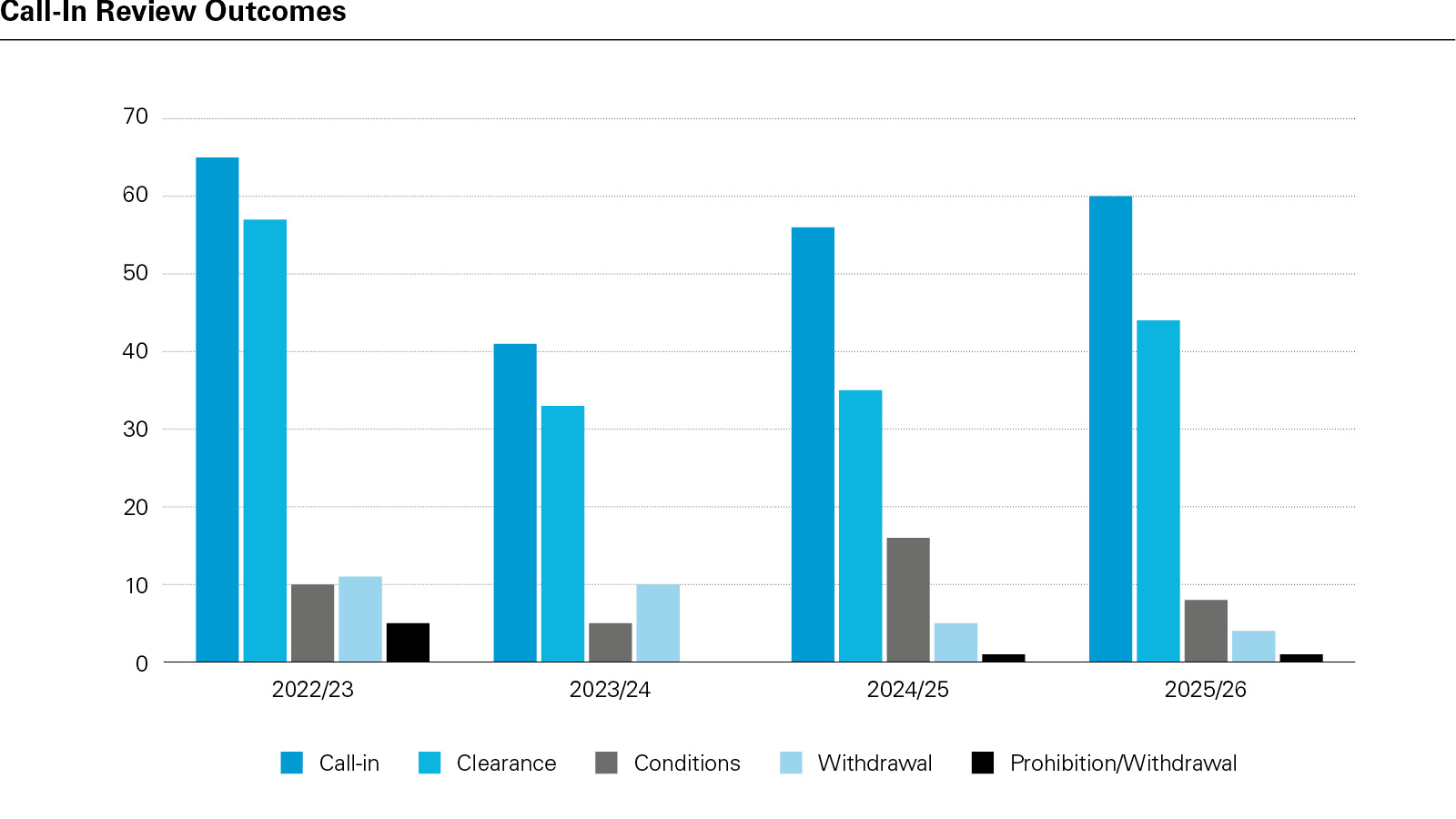
It remains the case that clearance without call-in notice is the norm, with nearly 96% of all notifications cleared without call-in review. During the NSIA Report Period, the government issued 60 call-in notices. This includes four call-in notices in respect of transactions that were not notified on any basis. This is a power that the government can exercise in respect of any qualifying transaction for up to 5 years from the date of closing.
Final Orders: Conditional and Prohibition Decisions
Following a call-in review, there are three potential outcomes:
- A final notification confirming no further action will be taken and so effectively clearing the deal unconditionally;
- A final order imposing conditions on designated parties; or
- A final order prohibiting the transaction (or, in the case of unnotified deals that have already been completed, unwinding the deal).
Of the 60 call-in notices issued in 2025/26, nine resulted in a final order. Of these, one prohibited a transaction. The remaining eight imposed conditions on transaction parties. Sample conditions have included:
- the imposition of information, physical, and personnel security requirements;
- compliance with security, governance and data-protection requirements; and
- notifying government before taking certain actions.
Sectoral Focus
The NSIA Report also provides a breakdown of the sectors of the economy triggering the most mandatory notifications, voluntary notifications, call-ins, final notifications (i.e., clearance after call-in), and final orders (i.e., the imposition of conditions or prohibition).
Defence remains the sensitive sector accounting for the majority of notifications with 58%. This is no doubt a function of the broad scope of the Defence sector definitions in the NSIA Regulations, which are capable of capturing even indirect subcontractors to the Ministry of Defence, operating in a broad range of activities. Other prominent sectors included Military and Dual Use (23%) and Critical Suppliers to Government (20%).2
A similar sectoral focus is also evident in the sectors most subject to call-in with Defence again accounting for the majority (50%), followed by Critical Suppliers to Government (30%), Military and Dual Use (27%) and Data Infrastructure (27%).
Investor Origin
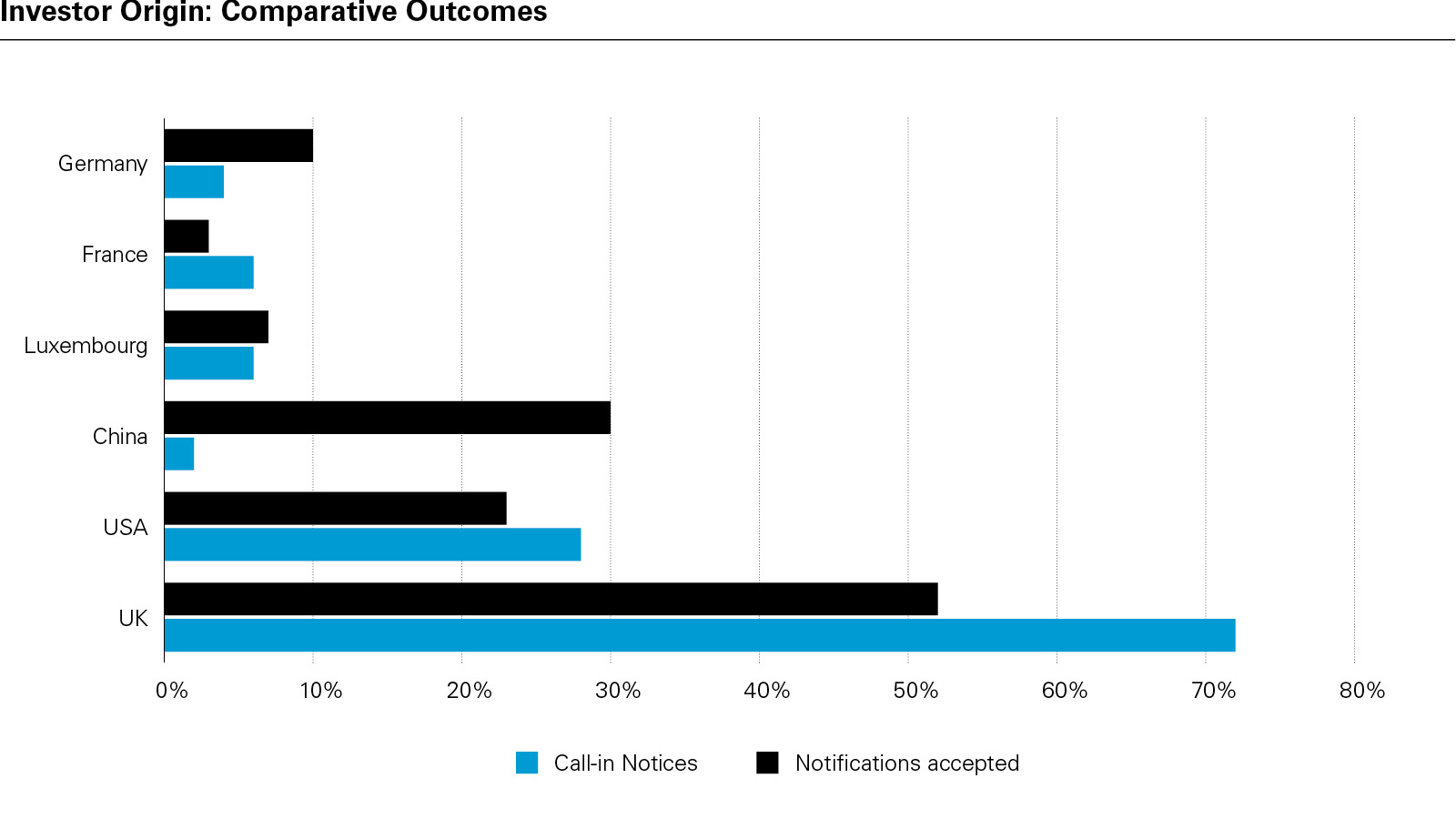
Unlike many other FDI regimes, the NSIA is agnostic as to an investor's origin when it comes to the obligation to notify a transaction. UK investors are, therefore, subject to the same notification requirements as overseas investors. Correspondingly it is UK investors who were responsible for the highest number of notifications during the NSIA Report Period accounting for 72% of all notifications received. UK investors also account for the largest percentage of call-in notices (52%) and five of the nine final orders (noting that investors may be attributed to more than one country of origin for these purposes). China remains something of an outlier, however. China represents 2% of notifications received but 30% of call-in notices received and three of the nine final orders.
Penalties
The NSIA sets out various offences, including the completion of a notifiable transaction without approval. Such offences can attract penalties of up to £10 million or 5% of turnover (whichever is the higher).
The NSIA Report states that, once again, no penalties were issued during the NSIA Report Period. Instead, the Cabinet Office has sought to take a pragmatic approach where instances of completing a notifiable acquisition without approval have been identified. During the NSIA Report Period, the Cabinet Office identified 43 of these but was satisfied with procuring assurances to prevent any recurrence rather than seeking penalties.
It remains the case, therefore, that since its introduction in January 2022, no penalty has been imposed under the NSIA for failing to notify a transaction that was subject to a mandatory filing obligation.
Outlook
The NSIA Report reiterates the government's commitment to update and adapt the NSIA with "forthcoming legislation". This is expected to exempt internal restructures and the appointment of liquidators from mandatory notification obligations.
The sensitive sectors defined in the NSIA Regulations are also expected to undergo an update, as detailed in the government's response to its October 2025 consultation on the sensitive sectors. These changes would include the creation of standalone sectors for critical minerals, semiconductors and computing hardware, the introduction of a new water sector, and updates to the existing descriptions capturing advanced materials, AI, communications, critical suppliers to government and to the emergency services, energy, data infrastructure and synthetic biology.
While the timeline for these changes is yet to be confirmed, in the interim it remains to be seen what approach new decision-maker Louise Haigh may bring to the operation of the regime as it undergoes further efforts to improve efficiency and clarity.
1 The Annual Report also contains revised figures for the 2024/25 reporting period to improve accuracy.
2 Transactions can be notified based on multiple sectors, with, for example, the Defence and Military & Dual-use sectors often triggering simultaneously, so the figures by sector will be somewhat skewed due to the overlapping definitions.
White & Case means the international legal practice comprising White & Case LLP, a New York State registered limited liability partnership, White & Case LLP, a limited liability partnership incorporated under English law and all other affiliated partnerships, companies and entities.
This article is prepared for the general information of interested persons. It is not, and does not attempt to be, comprehensive in nature. Due to the general nature of its content, it should not be regarded as legal advice.
© 2026 White & Case LLP

