Our thinking

New frontiers: How AI is transforming the life sciences industry

Taking the pulse of AI in the life sciences sector and exploring how organizations can maximize opportunities from this rapidly evolving technology to build healthier futures

Embracing change

The convergence of artificial intelligence (AI) and life sciences is no longer a distant promise. Companies operating in the sector are actively embracing the technology and are already achieving measurable results. In the following exclusive report from White & Case, in association with Mergermarket, this new reality is explored in depth. Drawing on a proprietary survey of senior executives spanning human pharma and biotech, healthcare provision, medical devices and animal health, the report provides a comprehensive overview of where the sector stands and where it may be heading.

Recent market data demonstrates the scale and urgency of this shift. AI in the pharma market alone is projected to reach US$25.7 billion by 2030, up from around US$4 billion today, according to market research firm Mordor Intelligence. AI-driven drug discovery is also expected to exceed US$20 billion by 2030, per research organization Grand View Research, as firms seek faster routes to novel compounds and more precise trial matching. These forecasts underscore that AI is much more than merely a back-office optimization tool; it is becoming integral to how life sciences companies design, test and deliver therapies, with growing expectations from regulators, investors and patients alike.

Our findings confirm this transition of AI from experimentation to practical application. Tools are being embedded in product design, trial optimization, diagnostics, drug target identification and commercial execution. Organizations are also adapting internally—reassessing governance structures, workforce capabilities and legal frameworks to ensure AI can scale sustainably and in compliance with complex legal frameworks. Board-level involvement is growing, and forward-looking investment strategies are being developed to match the pace of innovation.

This research explores the sector's priorities and pain points in detail. The report begins by mapping current use cases and business goals, showing how companies are deploying AI to address real operational needs—from shortening development cycles to improving diagnostic accuracy. It then turns to the structural challenges that remain, including the legal and regulatory complexities surrounding general AI deployment and use, data protection, intellectual property (IP) and cross-border compliance. These risks are shaping how organizations approach partnerships, procurement and policymaking.

Investment is a central theme. Budgets are shifting from discretionary pilots to embedded line items, with many companies pursuing joint ventures, acquisitions or internal buildouts to accelerate capability development. Local sourcing is often favored, but appetite for cross-border expansion remains in markets with advanced regulatory pathways or concentrated AI talent.

In conclusion, the report examines how success is being defined and why it matters. Metrics such as diagnostic accuracy, cost reduction, and patient access are becoming essential to both internal planning and external validation. Encouragingly, the vast majority of respondents believe AI will improve patient outcomes, while investors increasingly view AI maturity as a signal of innovation-readiness and long-term value creation.

With AI moving rapidly up the agenda in boardrooms and regulatory agencies, understanding how to scale responsibly and legally is critical. This report offers a grounded view of what effective AI adoption in life sciences looks like today—and where the next key opportunities and risks lie.

Methodology

In 2025, White & Case, in partnership with Mergermarket, surveyed 200 senior executives of life sciences organizations. The organizations surveyed included human pharma and biotech companies (75), healthcare providers (50), medical device companies (50) and animal health companies (25). Respondents from each company type were split equally between EMEA (66), Asia-Pacific (67) and North America (67).

The state of the market

organic molecules

Opportunities in AI

petri dish

Patient, commercial and regulatory concerns

DNA sequences

How companies are investing in AI

MRI scans

Conclusion: A healthy future for AI in the life sciences arena

Orion spacecraft

Five key takeaways

stethoscope
Orion spacecraft

Conclusion: A healthy future for AI in the life sciences arena

Insight
|
3 min read

Key takeaways

01

A clear majority believe the impact of AI on life sciences in the next 24 months will be transformational

02

Diagnostic accuracy is collectively viewed as the most reliable metric for judging the success of AI

03

Nearly all respondents agree that life sciences companies will become significantly less attractive to investors unless they effectively adopt AI tools in the next 24 months

04

Almost all respondents believe AI will improve patient outcomes in the next 24 months

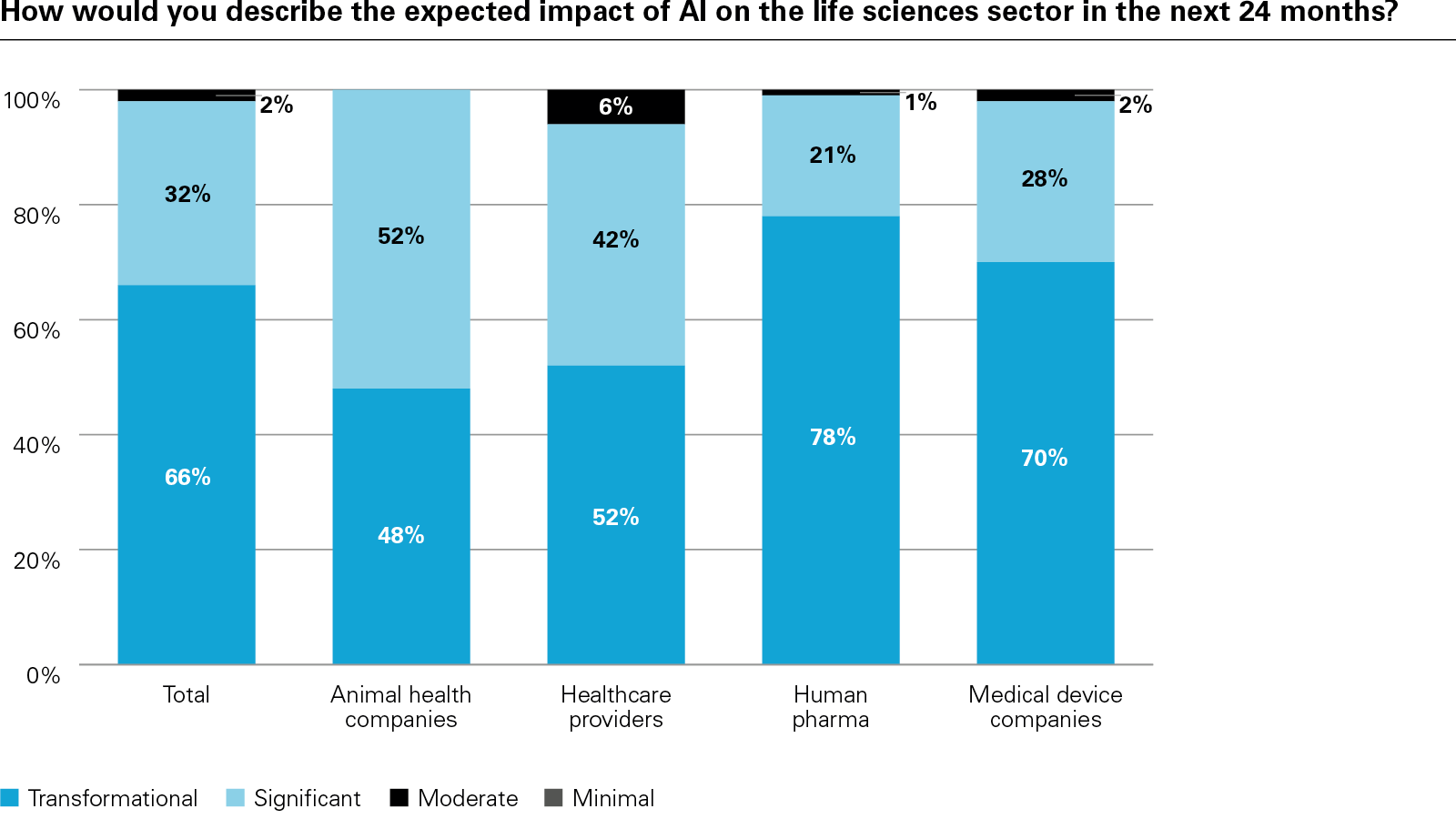
Embracing AI is a strategic imperative for companies across the life sciences value chain, with the technology now a prerequisite for innovation, efficiency and future-readiness. The overwhelming consensus from our survey respondents highlights the imminence of this change. Two thirds (66 percent) say AI's impact on life sciences in the next 24 months will be transformational.

This sentiment is strongest in human pharma (78 percent) and medical devices (70 percent), where AI is already being deployed for complex tasks such as drug discovery and diagnostic analysis. The share is lower, though still material, among healthcare providers (52 percent) and animal health companies (48 percent), reflecting tighter budgets, more fragmented data and heavier reliance on third-party tools.

"The impact will be huge. Companies that do not use AI frequently in their activities will fall behind the rest and the level of innovation will suffer," says the head of technology of a pharma company in Ireland.

The overwhelming consensus from our survey respondents highlights the imminence of this change. Two thirds (66 percent) say AI’s impact on life sciences in the next 24 months will be transformational.

This transformation cannot be achieved without first defining what success looks like. This ensures that budgets are aligned with outcomes, enabling further funding when positive results are delivered. Companies must set clear, measurable objectives so they understand exactly what they seek to achieve and whether those milestones are being met. AstraZeneca has publicly detailed internal tools, such as its Development Assistant, which allows clinical operations teams to query structured and unstructured data using natural language, backed by generative agents and retrieval-augmented generation. It was first launched as a proof of concept in mid-2024 and built into a production-ready MVP within six months, improving patient recruitment, site selection and clinical trial design.

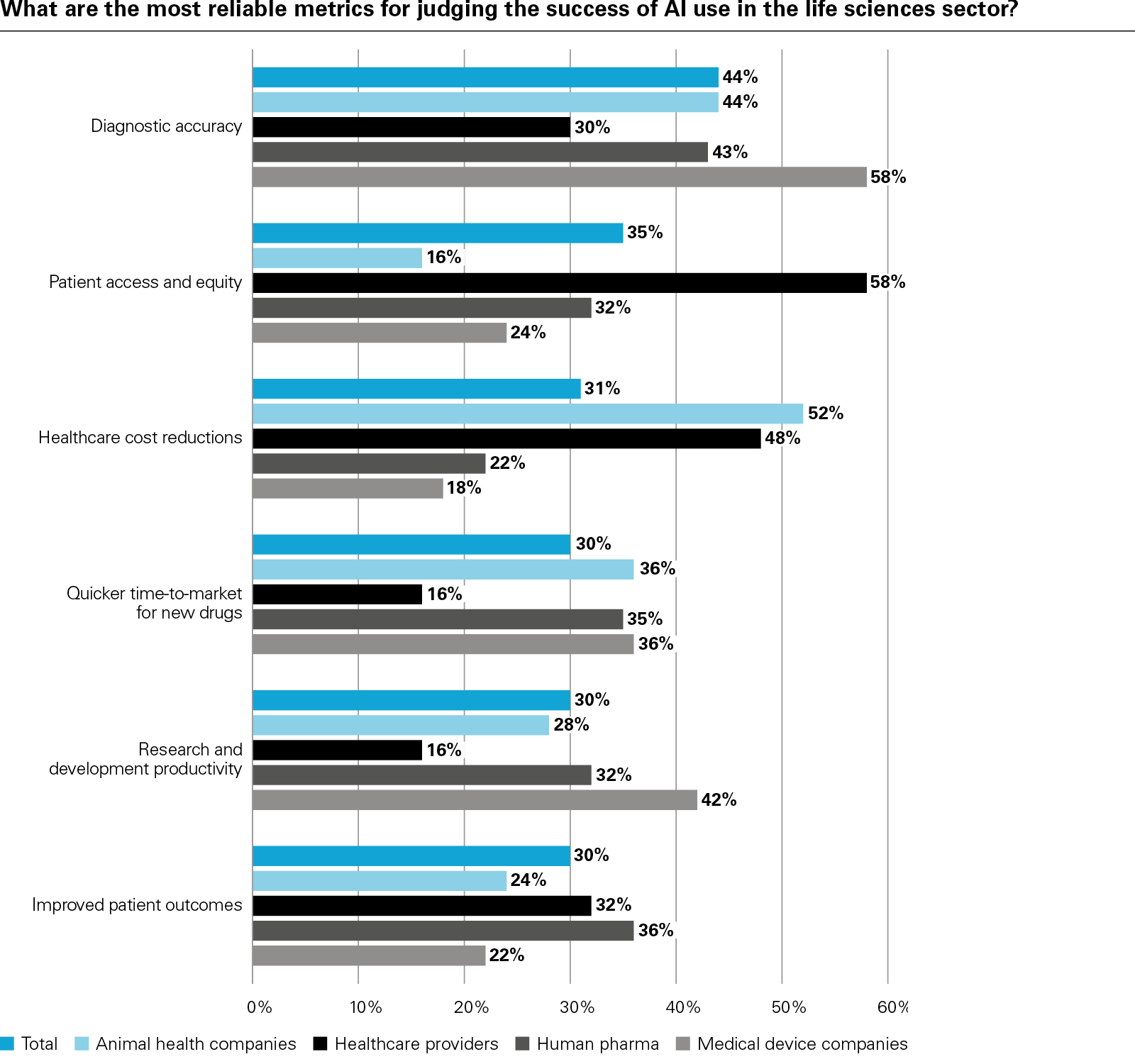
Metrics for success differ depending on each subsector's priorities. Diagnostic accuracy (44 percent) leads overall, rising to 58 percent for medical device companies. Meanwhile, healthcare providers, who are more directly concerned with patient-facing services, prioritize metrics related to patient access and health equity (58 percent). For animal health companies, the primary focus is on healthcare cost reductions (52 percent).

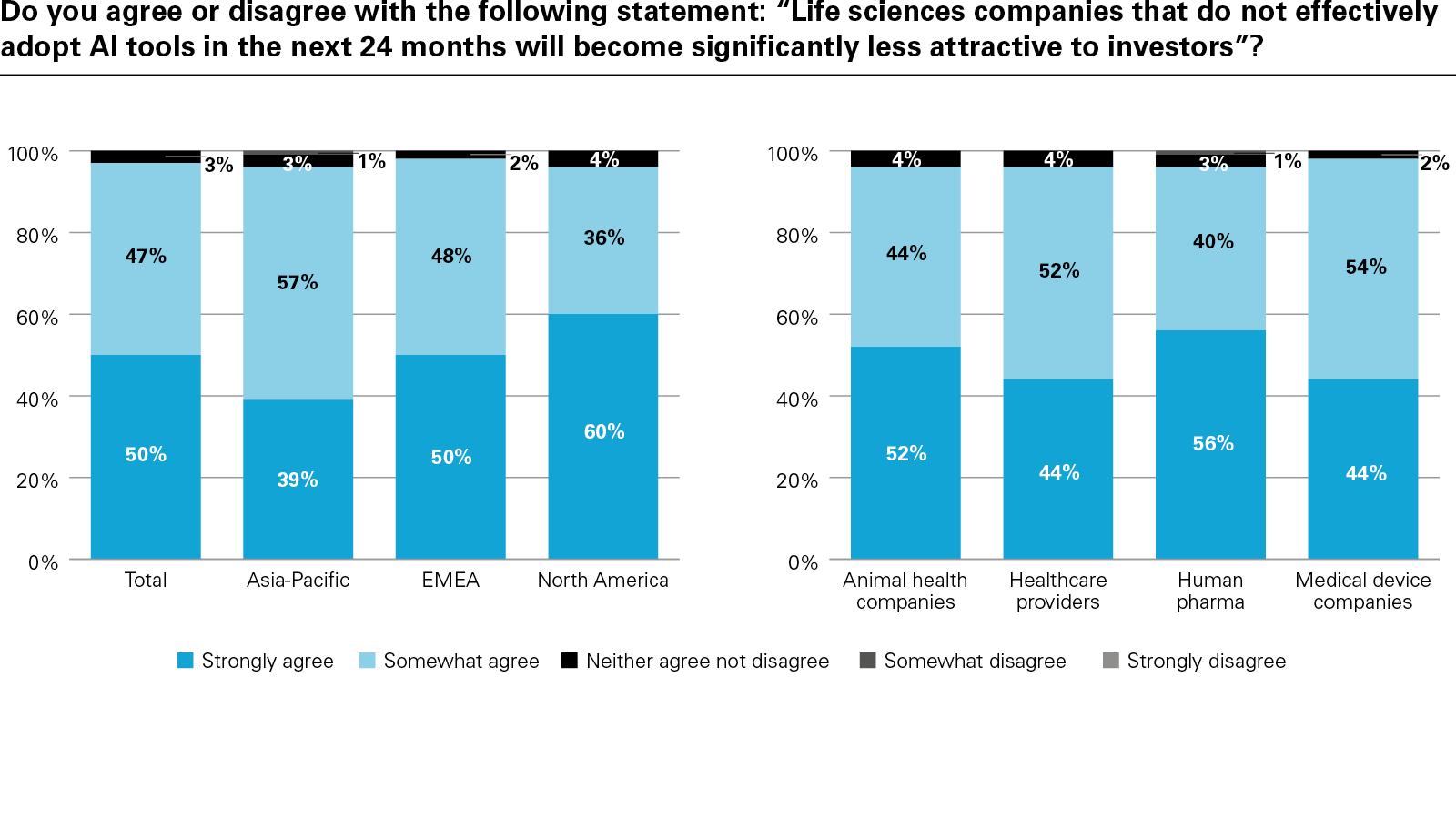
Access to capital has always been a competitive differentiator in life sciences, but with margins under pressure, R&D pipelines growing more complex and regulatory expectations intensifying, investors are becoming more selective. Increasingly, effective AI adoption is seen as a proxy for agility, data maturity and long-term value creation. Respondents are unanimous on this point: 97 percent agree that companies will be less attractive to investors unless they adopt AI effectively within the next 24 months. This includes 60 percent of North America–based and 50 percent of EMEA–based respondents who strongly agree. Asia-Pacific–based executives are more measured, with 57 percent somewhat agreeing.

While much of the focus on AI has centered on operational efficiency and commercial upside, its ultimate test will be its impact on care. Across the sector, the belief that the technology can improve patient outcomes is nearly universal—reflecting growing confidence in AI's ability to sharpen diagnoses, tailor interventions and support more consistent, equitable delivery.

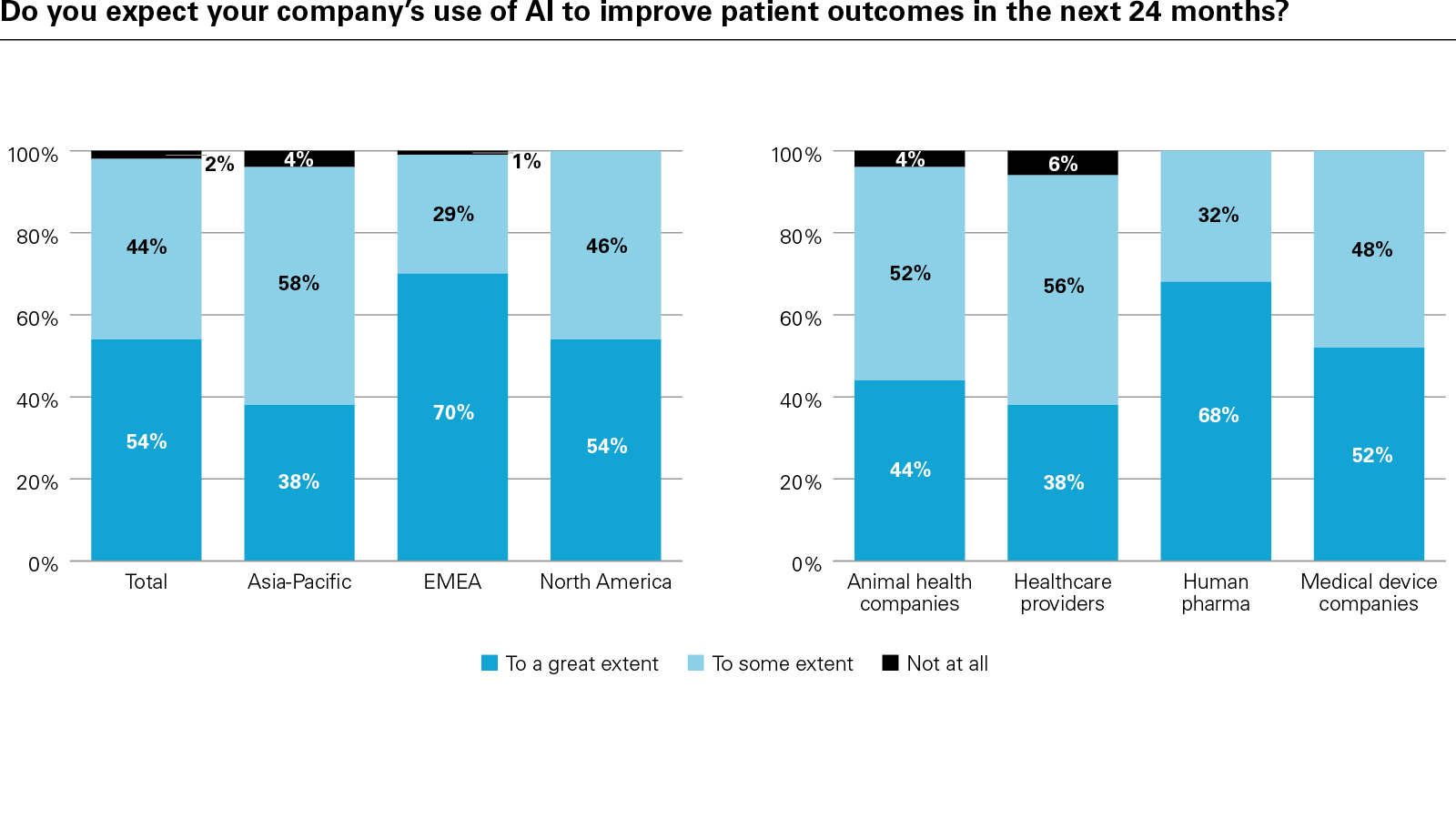
Nearly every respondent (98 percent) expects AI to improve patient outcomes to at least some extent, and in many cases, the expectations are high. Seven out of ten life sciences companies based in EMEA anticipate a great improvement over the next two years, a bullish view that reflects the region's regulatory momentum around digital health and concrete progress in imaging, diagnostics and care coordination.

Human pharma firms also stand out for their optimism, with 68 percent expecting a significant step forward in outcomes by 2027, with the remainder still anticipating at least moderate gains. Much of this confidence rests on AI's growing role in uncovering novel treatment pathways, including by improving how candidates are modeled and prioritized.

White & Case means the international legal practice comprising White & Case LLP, a New York State registered limited liability partnership, White & Case LLP, a limited liability partnership incorporated under English law and all other affiliated partnerships, companies and entities.

This article is prepared for the general information of interested persons. It is not, and does not attempt to be, comprehensive in nature. Due to the general nature of its content, it should not be regarded as legal advice.

© 2026 White & Case LLP

Top