New frontiers: How AI is transforming the life sciences industry
Taking the pulse of AI in the life sciences sector and exploring how organizations can maximize opportunities from this rapidly evolving technology to build healthier futures
Embracing change
The convergence of artificial intelligence (AI) and life sciences is no longer a distant promise. Companies operating in the sector are actively embracing the technology and are already achieving measurable results. In the following exclusive report from White & Case, in association with Mergermarket, this new reality is explored in depth. Drawing on a proprietary survey of senior executives spanning human pharma and biotech, healthcare provision, medical devices and animal health, the report provides a comprehensive overview of where the sector stands and where it may be heading.
Recent market data demonstrates the scale and urgency of this shift. AI in the pharma market alone is projected to reach US$25.7 billion by 2030, up from around US$4 billion today, according to market research firm Mordor Intelligence. AI-driven drug discovery is also expected to exceed US$20 billion by 2030, per research organization Grand View Research, as firms seek faster routes to novel compounds and more precise trial matching. These forecasts underscore that AI is much more than merely a back-office optimization tool; it is becoming integral to how life sciences companies design, test and deliver therapies, with growing expectations from regulators, investors and patients alike.
Our findings confirm this transition of AI from experimentation to practical application. Tools are being embedded in product design, trial optimization, diagnostics, drug target identification and commercial execution. Organizations are also adapting internally—reassessing governance structures, workforce capabilities and legal frameworks to ensure AI can scale sustainably and in compliance with complex legal frameworks. Board-level involvement is growing, and forward-looking investment strategies are being developed to match the pace of innovation.
This research explores the sector's priorities and pain points in detail. The report begins by mapping current use cases and business goals, showing how companies are deploying AI to address real operational needs—from shortening development cycles to improving diagnostic accuracy. It then turns to the structural challenges that remain, including the legal and regulatory complexities surrounding general AI deployment and use, data protection, intellectual property (IP) and cross-border compliance. These risks are shaping how organizations approach partnerships, procurement and policymaking.
Investment is a central theme. Budgets are shifting from discretionary pilots to embedded line items, with many companies pursuing joint ventures, acquisitions or internal buildouts to accelerate capability development. Local sourcing is often favored, but appetite for cross-border expansion remains in markets with advanced regulatory pathways or concentrated AI talent.
In conclusion, the report examines how success is being defined and why it matters. Metrics such as diagnostic accuracy, cost reduction, and patient access are becoming essential to both internal planning and external validation. Encouragingly, the vast majority of respondents believe AI will improve patient outcomes, while investors increasingly view AI maturity as a signal of innovation-readiness and long-term value creation.
With AI moving rapidly up the agenda in boardrooms and regulatory agencies, understanding how to scale responsibly and legally is critical. This report offers a grounded view of what effective AI adoption in life sciences looks like today—and where the next key opportunities and risks lie.
Methodology
In 2025, White & Case, in partnership with Mergermarket, surveyed 200 senior executives of life sciences organizations. The organizations surveyed included human pharma and biotech companies (75), healthcare providers (50), medical device companies (50) and animal health companies (25). Respondents from each company type were split equally between EMEA (66), Asia-Pacific (67) and North America (67).
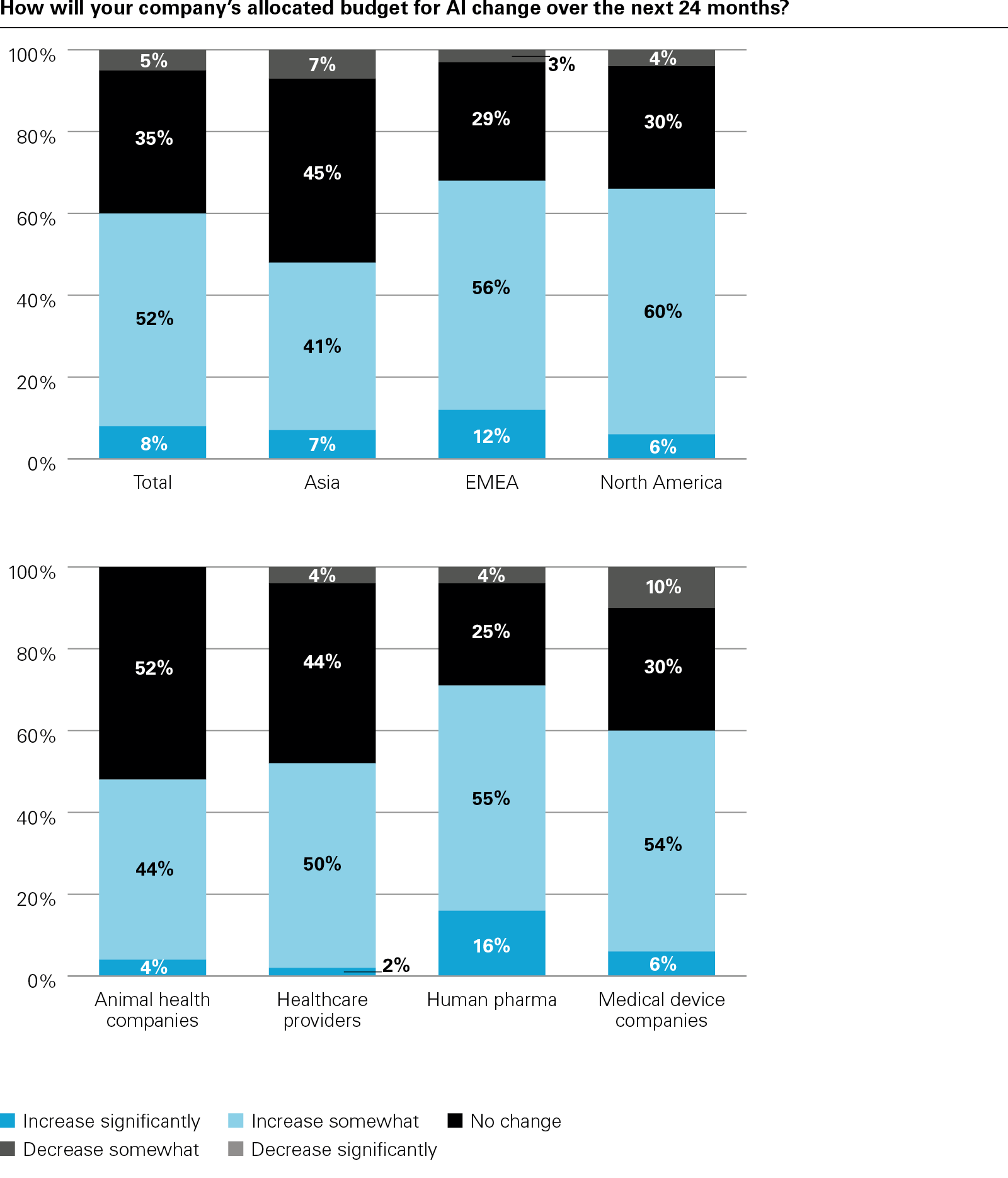
A clear majority of organizations intend to increase their budgets for AI in the next 24 months
02
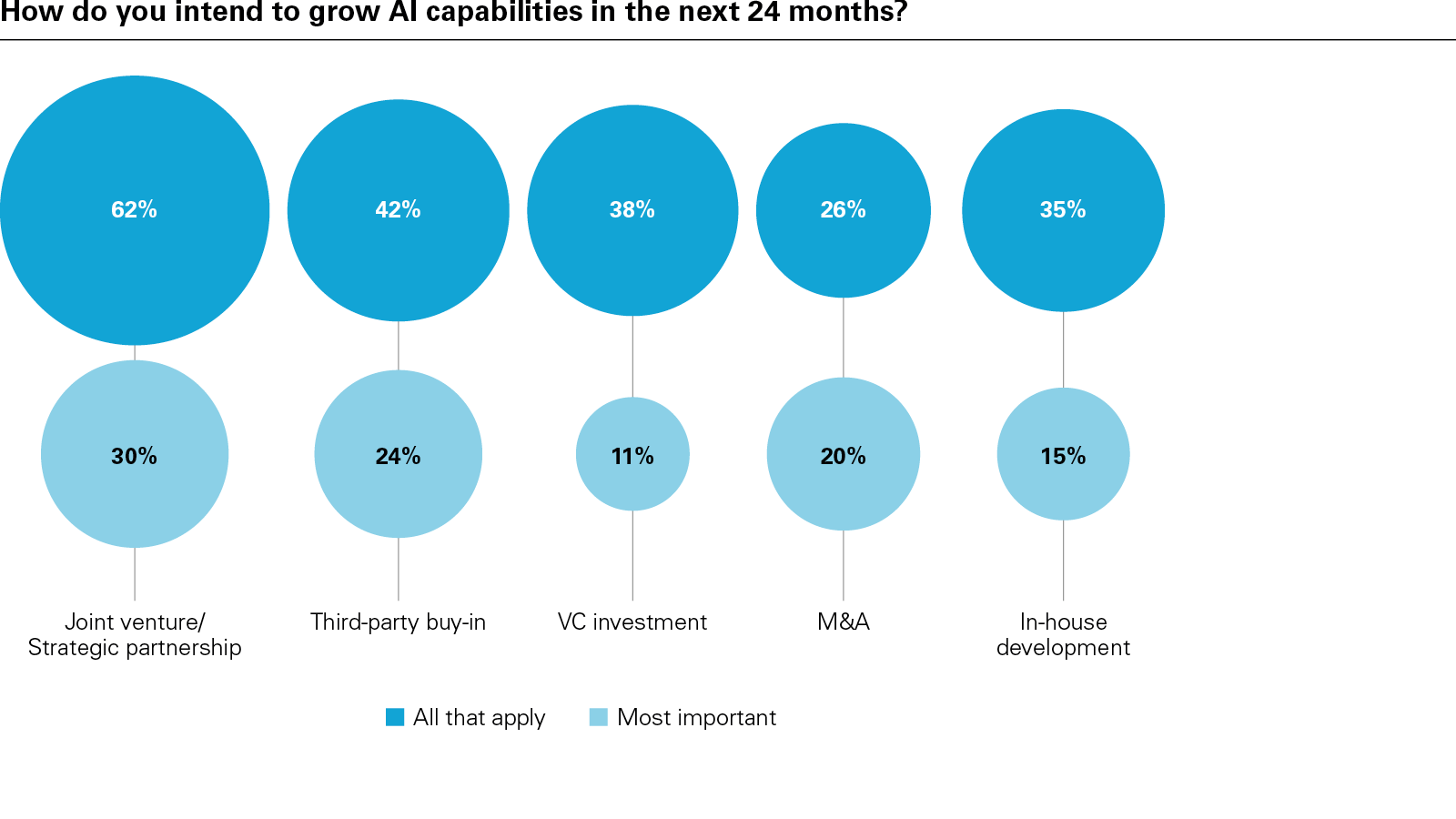
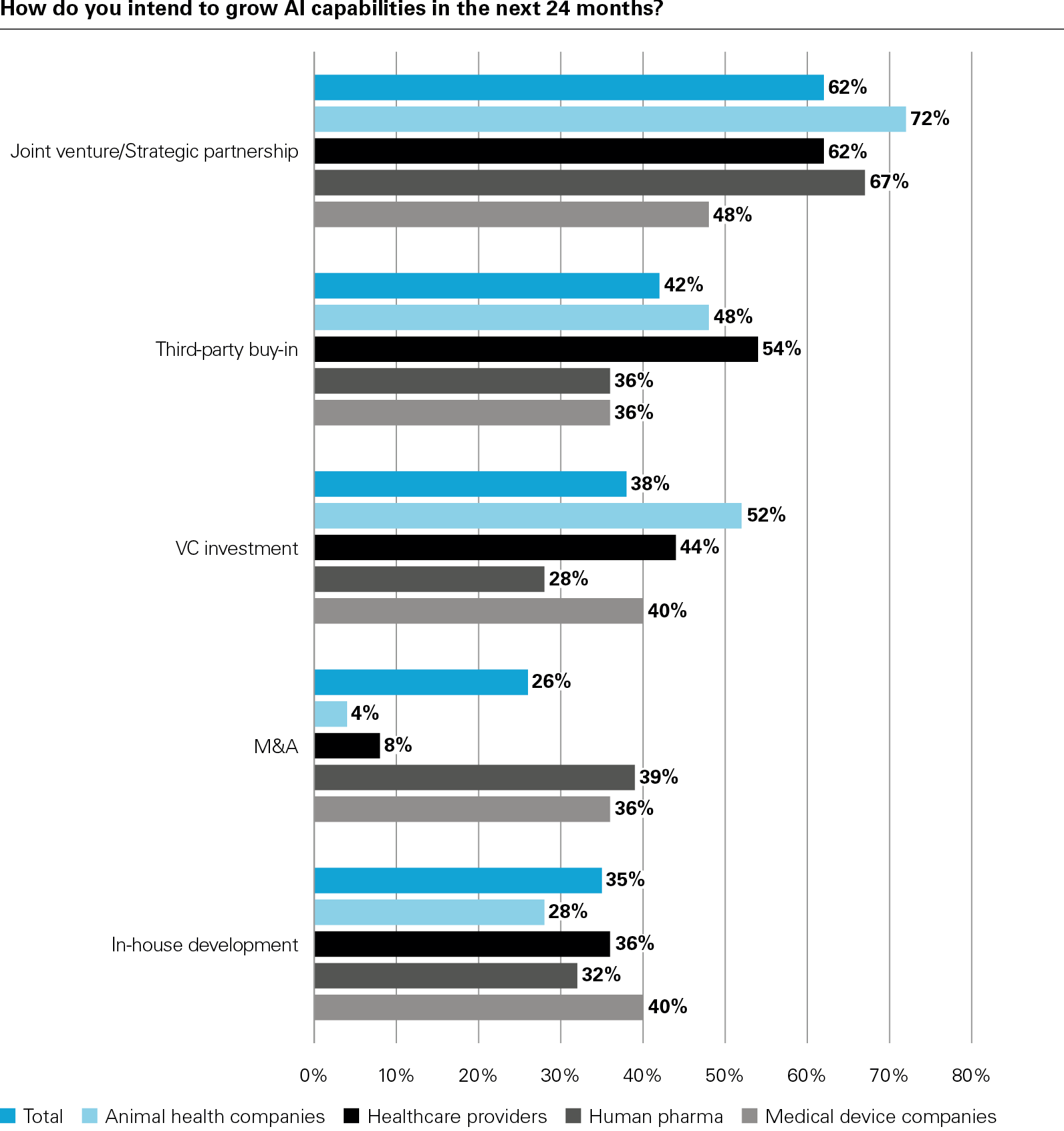
Joint ventures/Strategic partnerships are the most popular method for growing AI capabilities
03
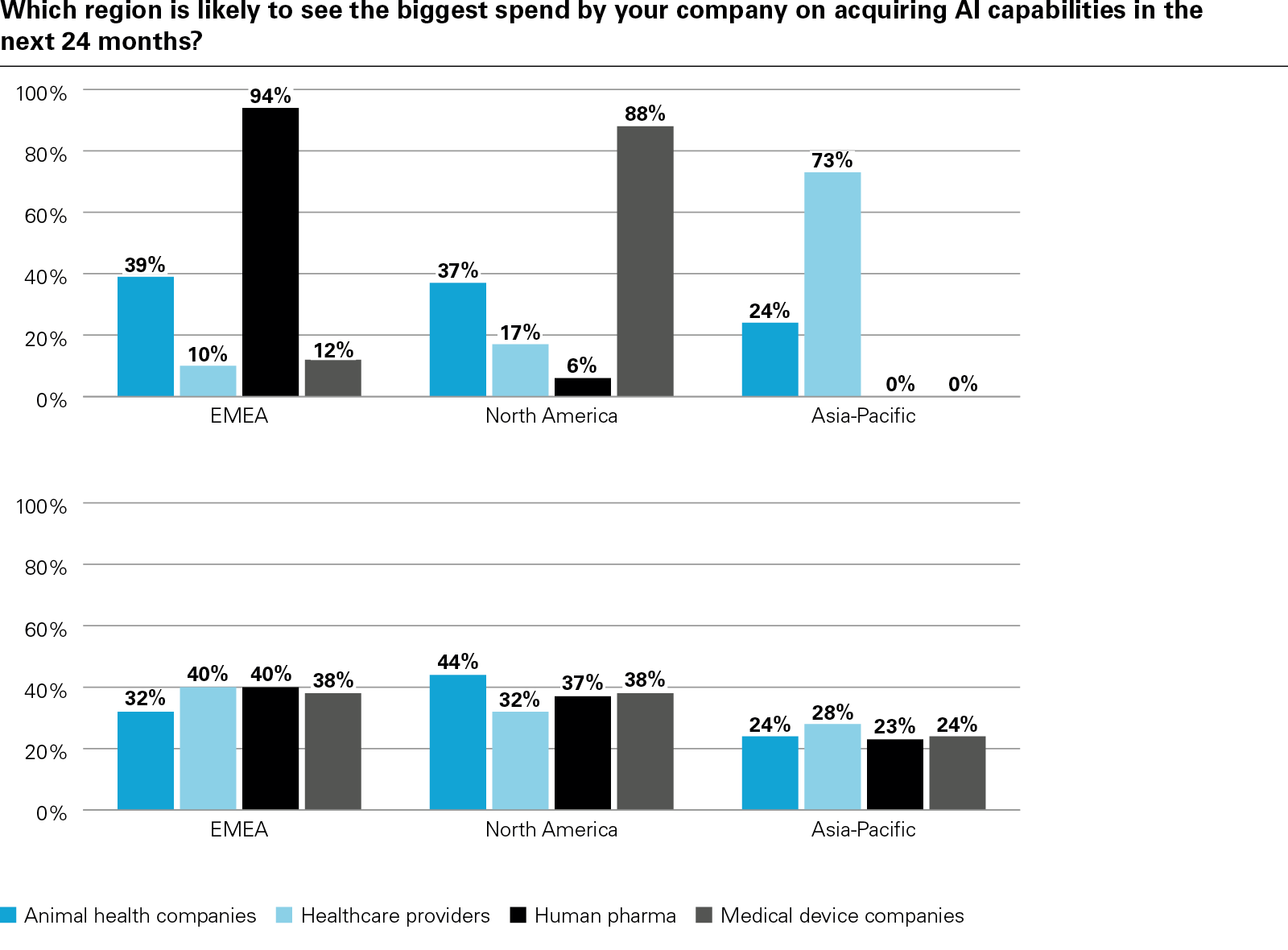
Most organizations expect their biggest spend on acquiring AI capabilities to be within their own regions rather than cross-border
Across the life sciences sector, funding is being tied more closely to operational goals. Risk and legal teams are setting boundaries around data use, model oversight and accountability, while finance teams are unlocking budgets where ROI can be clearly demonstrated. Against this backdrop, investment intentions are rising. Partnership models are the preferred route to scale, and most organizations plan to source capabilities close to home.
60%
Percentage of respondents who expect to increase their company’s allocated budget for AI over the next 24 months
Most expect to spend more on AI in the next two years: 60 percent anticipate larger budgets within 24 months, rising to 71 percent in human pharma. This shift reflects a grounded approach. Teams are increasingly framing AI projects in terms of measurable outputs: fewer redesign cycles in development; improved enrollment forecasts in trial; earlier trend detection in safety; and greater predictability at launch. As a result, funding is moving from discretionary pilots to line items embedded in R&D, quality, supply chain and commercial plans.
"In order to make AI systems flexible and more fit-for-purpose, the spend has to be increased,” says the CFO of a US healthcare provider. "However, we are still unsure about the value that can be derived from AI functions and how long it will take to see promised returns.”
Research from the Boston Consulting Group indicates that returns are strongest when companies concentrate their resources. Across sectors, organizations that focus on a small number of high-impact use cases (about 3.5 on average) report about 2.1× higher ROI than peers pursuing a broader range (6.1 use cases). The implication for life sciences is clear: Higher AI budgets are more likely to deliver value where scope is focused, data access is pre-cleared and outcomes are tracked against well-defined business goals.
Joint ventures and strategic partnerships top the list of planned expansion models. Some 62 percent of respondents plan to use partnerships in the next two years, and 30 percent cite this as their most important investment route. The logic is pragmatic: Partnerships offer faster access to trained models, specialized tooling and scarce AI talent—while allowing both parties to evaluate technical compatibility, data interoperability and governance fit before making further long-term commitments.
A vice president of a life sciences multinational explains the importance of partnerships over outright acquisitions, saying: "We've always been agnostic about where innovation comes from, whether internally or externally. That said, there's a definite trend toward more collaborations and licensing in the life sciences sector, especially to derisk. Acquisitions are costly and complex—you have to integrate systems and people, which isn't always straightforward. Licensing or partnerships allow us to set milestones and assess progress along the way. In some cases, that also includes an option to acquire later.”
In September 2025, Eli Lilly launched TuneLab, opening up its AI/ML discovery models, trained on more than US$1 billion worth of internal R&D data, to external biotechs, with initial partners including AI-enabled drug discovery and development company insitro. In parallel in the fall of 2025, Lilly announced collaborations aimed at advancing AI-assisted drug discovery, including a collaboration with insitro to build novel ML models to advance small-molecule discovery, a collaboration with Insilico Medicines to generate and design candidate compounds using Insilico's Pharma. AI platform, and a collaboration with NVIDIA to build an AI supercomputer to expand the scope of designing and testing potential compounds across multiple therapeutic indications.
Such alliances are an increasingly common sight. The same month, Novartis and Monte Rosa Therapeutics struck a licensing deal worth up to US$5.7 billion in immune-mediated diseases.
Monte Rosa's AI-enabled QuEEN platform will be used to develop selective protein degraders, while Novartis leads clinical development and commercialization—clear evidence that AI-powered design is already reshaping early-stage drug development. This type of partnership model allows companies to combine their expertise and resources. A joint venture between a pharma or healthcare company and an AI company can often deliver stronger and faster results by combining the expertise of both parties.
Life sciences companies working in association with a third party can lead to out-of-the-box thinking, which may be stifled when building internally. On the other hand, tech-native companies that also operate in healthcare often prefer to build in-house rather than partner, because they already have strong data-science capabilities and can rely on those internally.
27%
Percentage of Asia-Pacific–based respondents who expect their primary AI investment to go to either North America or EMEA
M&A remains on the table, where full control over platforms, datasets or people is essential. Among human pharma companies, 39 percent expect to pursue acquisitions to deepen their AI capability. These cases typically involve deep integration into R&D or quality systems, where proprietary models must be validated, improved and governed in-house over time. Due diligence focuses on data rights, open-source usage, code provenance, cyber risk posture, and whether operations can be reliably scaled and validated post-acquisition.
Elsewhere, third-party buy-ins and venture capital investments are more common. In animal health and healthcare providers, 48 percent and 54 percent, respectively, plan to pursue buy-ins, while 52 percent and 44 percent are looking at VC investments. Buy-ins suit use cases where a plug-and-play tool can be dropped into existing workflows with limited modification.
Venture investments, on the other hand, offer exposure to emerging tools and partnerships without immediate operational commitments. These are often structured with commercial options or first-look rights to deepen engagement if performance meets expectations.
Most organizations expect the bulk of their AI investment over the next two years to remain regional. Local sourcing minimizes complications around data transfer, employment law and compliance—and is often better aligned with language, regulatory expectations and time zones.
That said, some firms are looking further afield. Asia-Pacific–based respondents are the most internationally focused: 27 percent expect their primary AI investment to go to North America or EMEA. This contrasts sharply with EMEA–based respondents, only six percent of whom expect their biggest AI investment to go outside the region, and only into North America. These findings reflect the gravitational pull of US-based AI vendors, startups and service providers, which are widely viewed as market leaders.
The US, in particular, is a natural target. Private investment in AI reached an estimated US$109 billion in 2024, by far the highest globally, while North America accounts for 49.3 percent of the global AI-in-healthcare market. The vendor ecosystem spans foundational model providers, life sciences-specific platforms, data engineering specialists and sector-aligned consulting firms.
Regulatory enablers are also stronger than in many other jurisdictions. The FDA maintains a public list of AI/ML-enabled medical devices and has authorized more than 1,200 to-date, 235 of them in 2024 alone, the most ever in a single year. The agency has also published frameworks around algorithm change control and Good Machine Learning Practice (GMLP), helping reduce ambiguity around compliance and review standards. This makes the US especially attractive for device makers and digital health companies seeking a clearer pathway to regulatory approval.
White & Case means the international legal practice comprising White & Case LLP, a New York State registered limited liability partnership, White & Case LLP, a limited liability partnership incorporated under English law and all other affiliated partnerships, companies and entities.
This article is prepared for the general information of interested persons. It is not, and does not attempt to be, comprehensive in nature. Due to the general nature of its content, it should not be regarded as legal advice.