

FERC orders grid operators to promptly revise or justify interconnection rules for data centers and large loads
18 min read
On June 18, 2026, the Federal Energy Regulatory Commission (FERC) issued six show cause orders initiating proceedings under Section 206 of the Federal Power Act (FPA) for all jurisdictional regional transmission organizations (RTOs) and their respective transmission owners (TOs).1 Stemming from a directive by the United States Department of Energy (DOE),2 the orders instruct the RTOs and TOs to explain why their existing open access transmission tariffs (OATTs) are just and reasonable with respect to interconnection processes for large loads.
Executive summary
At the June open meeting, FERC issued six orders to show cause to the six RTOs regarding how large loads interconnect to the transmission grid, pay for network upgrades, and pay for transmission service. FERC defined large loads as those with a peak load in excess of 50 MW that interconnect to transmission lines greater than 69 kV. The orders set out five categories of reforms and require the RTOs to demonstrate how their tariffs currently comply — or propose reforms to comply. FERC explained that the show cause orders are intended to accelerate speed-to-power timelines for hyperscalers and data center operators through flexible, region-specific reforms while establishing strict financial safeguards and preserving state authority to shield residential ratepayers from misaligned cost allocation.
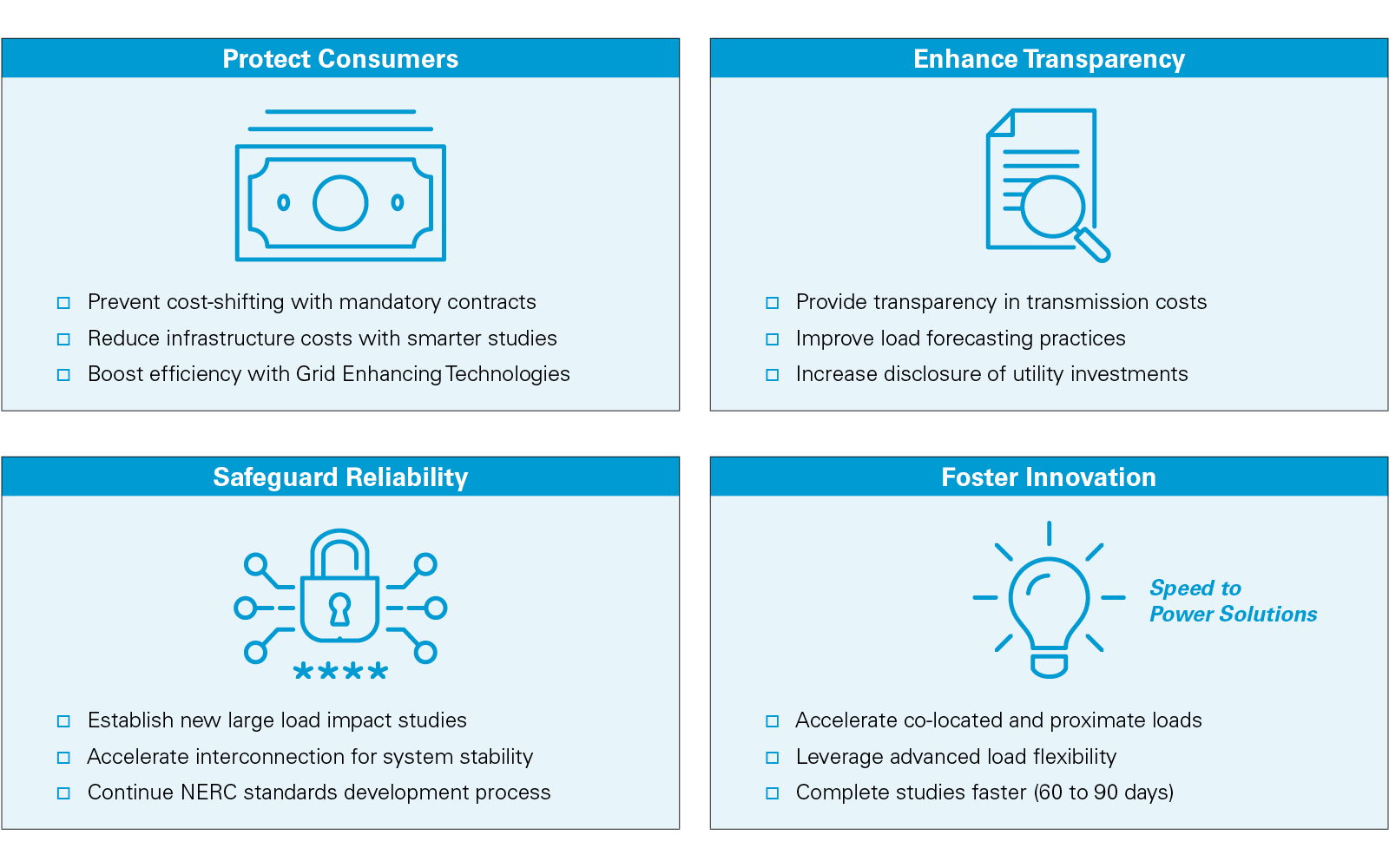
Commissioner David Rosner shared the below image setting forth the four pillars of FERC's response:3
Click here to view the image in PDF
The five areas of reform are:
- Efficient study processes. FERC sets out interconnection process requirements, including a requirement for the RTOs and TOs to consider alternative transmission technologies and, if not used, explain why not.
- Cost transparency and recovery. The show cause orders require the RTOs and TOs to enter into cost recovery agreements with large load customers whereby those customers make a minimum financial contribution to the TO's revenue requirement secured by strict credit support.
- Co-location rules. The show cause orders direct the RTOs to create dedicated, expedited study processes for generating facilities serving electrically proximate (within two buses or substations) and co-located large loads.
- New transmission services. FERC instructs the RTOs to develop new transmission services tailored to the operational characteristics of large loads during periods of system constraints and to offer interim, non-firm services to support interconnection while network upgrades may be underway.
- Large, flexible loads. The show cause orders direct the RTOs to consider how to incorporate large, flexible loads that are able to reduce their demand during periods when the grid is strained, including the potential creation of new transmission services.
Significantly, the show cause orders are targeted only at the RTOs; FERC left the ANOPR rulemaking docket open for potential action in non-RTO regions. The RTOs and TOs must file informational reports within 30 days on generation adequacy for existing and new large loads and must respond to the show cause orders within sixty days to either justify their existing tariffs or propose tariff changes. Parties will have the opportunity to comment on the RTOs' responses within 30 days.
Procedural history
On October 23, 2025, DOE invoked Section 403 of the Department of Energy Organization Act to submit a letter and advance notice of proposed rulemaking (ANOPR) to FERC to initiate a proceeding to accelerate large load interconnections. DOE asserted that FERC holds jurisdiction over the interconnection of large loads directly to the interstate transmission system.
In the proposal, DOE offered an initial framework of principles for facilities of 20 megawatts or greater, recommending standardizing study deposits, studying load concurrently with generation, and assigning 100 percent of network upgrade costs to the interconnecting load. For more insight on the DOE directive, please refer to our prior alert: DOE directs FERC to accelerate interconnection of data centers.
Subsequently, FERC opened a rulemaking docket, accumulating an administrative record of over 3,500 pages of comments from nearly 175 industry stakeholders and interested parties. For a comprehensive overview of the comments filed in the rulemaking proceeding, please refer to the summary of meeting agenda item E-1 in our prior alert: Summary of FERC Meeting Agenda for June 2026.
FPA Section 206 strategy
In a late modification to its agenda on the eve of the June 2026 open meeting, FERC signaled a procedural shift by opening six new EL dockets, one for each FERC-jurisdictional RTO, and striking the agenda item for the originating rulemaking proceeding. By leveraging its authority under Section 206 of the FPA, FERC contends that certain tariff provisions are unjust and unreasonable and, accordingly, compels each RTO to modify or add language to fully comply with the FPA. This shift moved FERC away from a generic industry-wide rulemaking and toward individualized tariff proceedings, placing the immediate burden on the RTOs and TOs to formally defend their existing procedures or submit compliance filings aligning with the five areas of reform in the show cause orders.4
FERC's procedural choice to proceed under Section 206 is not without risk. The use of six concurrent, show cause proceedings may constrain meaningful participation and create procedural uncertainty for parties seeking to preserve their rights across multiple dockets. FERC's decision not to adopt a single, uniform national standard in favor of region-specific reforms may also raise concerns regarding consistency and fairness across markets. Further, whether the record — drawn primarily from a generic rulemaking rather than an RTO-specific adjudicatory proceeding — is sufficient to sustain a Section 206 determination remains an open question.
Federal-state jurisdictional friction
The jurisdictional tension permeating the show cause orders originates from the ANOPR, where DOE argued that large load interconnections constitute a critical component of open access transmission service. Acknowledging that FERC historically avoided exerting jurisdiction over load interconnections, DOE proposed that linking data centers directly to the interstate transmission system requires minimum federal terms and conditions to ensure just and reasonable wholesale rates across the entirety of the U.S. In the ANOPR, DOE claimed this novel approach would not infringe upon state authority over retail sales or generation siting, but the potential jurisdictional expansion drew opposition from state regulators who govern retail utility rates.
FERC limited the show cause orders to the six RTOs and expressly declined to assert any new jurisdiction over large load interconnections, framing its directives as "falling squarely" within FERC's exclusive authority to ensure that transmission provider and/or TO tariffs include sufficiently clear and consistent provisions governing how transmission service to large loads will be studied. During her open meeting remarks, Chairman Swett stated, while interconnecting generation to the interstate grid remains squarely a federal responsibility, the directives do not intrude on the authority of states to select generation resources, dictate interconnection locations, or regulate retail sales. FERC similarly asserts in the show cause orders that it has acted to guard against wholesale cost misallocation among transmission customers and that the jurisdictional hook it invokes — that network upgrade costs driven by large load additions are inputs to Commission-jurisdictional rates — is broad enough to support the full range of reforms the orders contemplate.
Whether FERC's jurisdictional line fully resolves the federal-state tension is less certain. FERC acknowledges that resolving issues related to large load additions "will require the involvement of both federal and state actors," and that states maintain the responsibility to prevent retail cost shifting by, for example, creating new rate classes and properly assigning upgrade costs in retail tariffs. Commissioner Chang's concurrence acknowledged the tension more directly, expressing hope that FERC's decision not to pursue "the broad assertion of jurisdictional authority contemplated in the [ANOPR]" would "assuage concerns raised by our state colleagues" — while simultaneously welcoming "feedback from our state colleagues and others if they believe the Commission's preliminary findings raise jurisdictional concerns," signaling that FERC anticipates continued debate and potential challenges to its jurisdictional framing. Chairman Swett stated during the open meeting that "free riding" by data centers (i.e., retail customers bearing an undue burden) is not an option, but the orders leave the primary tools for preventing that outcome in state hands.
While this action is a significant step, FERC also signaled a willingness to go beyond the show cause orders, if necessary. In his open meeting remarks, Commissioner David A. LaCerte emphasized that states must take swift action to ensure their large load tariffs dovetail with federal efforts, saying: "While the Commission has refrained from exercising the full extent of its transmission jurisdiction in the past, we will not hesitate to do so if our hand is forced, and so much is at stake."
Substantive reforms and priorities
At the open meeting, Commissioner David Rosner conceptually framed the effort across four pillars: protecting consumers, enhancing transparency, safeguarding reliability, and fostering innovation.6 To implement these reforms, FERC instructed the RTOs and TOs to submit OATT revisions addressing five specific categories, mandating the following structural changes:7
- Transmission service application and study process: The show cause orders establish a definition for large loads, capturing any single-site commercial or industrial customer that is not part of a co-location arrangement, with a peak load of 50 megawatts or greater interconnecting at a voltage level above 69 kilovolts. FERC directed the RTOs to implement clear transmission service application rules and readiness requirements that escalate during the study process to deter speculative requests, including a requirement for Eligible Customers8 to disclose substantially similar pending transmission service requests. FERC found that the study process should take no more than 60 to 90 days. Additionally, FERC directed RTOs and TOs to address whether their tariffs should require 1) the evaluation of alternative transmission technologies (such as dynamic line ratings or advanced power flow control devices) without a specific request from the Eligible Customer, and, if traditional network upgrades are selected, 2) a sufficiently clear demonstration by the grid operator of why alternative technologies were not feasible or cost-effective. The orders also direct TOs to require hourly load forecasts, real-time telemetry, ramp rate and ride-through requirements, and the installation of phasor measurement units and remote disconnect capabilities at the customer's expense. FERC expects RTOs to memorialize these obligations within a pro forma transmission service agreement.
- Cost recovery agreements and ratepayer protection: To evaluate network upgrade funding, the show cause orders require a pro forma cost recovery agreement executed between the RTO, the relevant TO, and the Eligible Customer. This agreement requires the Eligible Customer to make a minimum financial contribution to the TO's revenue requirement secured by strict credit support based on the requested megawatt capacity. To avoid duplicative financial burdens, FERC noted that Eligible Customers may satisfy this requirement using credit support posted by the large load customer under a separate retail agreement. According to FERC, this mechanism is designed to address the "no-show" problem by placing the financial risk of a data center failing to materialize on the Eligible Customer rather than on other transmission customers who would otherwise bear stranded network upgrade costs. FERC also states that this mechanism is intended to resolve the timing mismatch problem, preventing grid upgrade costs from impacting existing customer bills before the large load is fully online and energized. To enhance transparency and to provide clear advance market signals, FERC directed the RTOs to post searchable, filterable data detailing specific large load additions and their associated network upgrade cost estimates prior to interconnection.
- Co-location arrangements, ancillary services, and netting: FERC instructed grid operators to formulate precise rules accommodating co-located arrangements. FERC clarified that interconnection customers may request service below a generating facility's maximum output and may utilize provisional or surplus interconnection service to accelerate development. FERC also clarified that co-located loads rely upon, and benefit from, grid stability. Accordingly, FERC directed grid operators to propose tariff provisions under which Eligible Customers taking service on behalf of co-located loads would be required to pay for regulation service and black start service on a gross demand basis, even if the load does not actively withdraw energy from the interstate transmission system. The show cause orders explicitly target legacy behind-the-meter generation rules by determining that allowing large loads to net their on-site generation against their demand to reduce wholesale transmission service charges is unjust and unreasonable. FERC directed the grid operators to establish a strict megawatt materiality threshold to limit such netting practices.
- New transmission services for flexible large loads: FERC directed the RTOs to implement new transmission services tailored for flexible large loads capable of limiting their energy withdrawals during grid stress. Grid operators must deploy interim network integration transmission service (NITS) while upgrades are constructed, alongside permanent firm and non-firm contract demand transmission services. Eligible Customers utilizing these flexible services must install specialized control technologies and protection schemes to ensure their withdrawals do not exceed approved limits.
- Generation serving electrically proximate load: FERC directed the RTOs to create dedicated, expedited study processes for generating facilities serving electrically proximate and co-located large loads. The show cause orders define an electrically proximate load as a facility located within two buses (or no more than two substations) of the generating unit. According to Commissioner Rosner, studying load and generation within this two-bus threshold is critical because it isolates the physical impacts locally and utilizes existing transmission infrastructure. The show cause orders also direct the RTOs to establish interconnection services that reflect a developer's commitment to limit a generating facility's output to strictly match the hourly forecast of the proximate load.
Accounting for regional differences
The orders acknowledge that transmission service models and planning responsibilities vary significantly across regions. To accommodate these structural differences, FERC afforded each RTO the ability to formulate operational requirements particular to its region.
Through these individual dockets, FERC conducted a granular review of the current framework for each region to tailor its directives, evaluating existing firm point-to-point and network integration transmission services, local transmission planning processes, and generator interconnection procedures. The show cause orders identify what FERC preliminarily finds to be a lack of sufficiently clear and consistent tariff provisions for addressing the challenges posed by substantial load growth, driven in significant part by the proliferation of artificial intelligence and cloud services.
For instance, FERC contends that in some regions, TOs take the lead in studying load interconnections, yet these critical study processes and engineering requirements remain entirely absent from the jurisdictional tariff. According to FERC, those regions often rely on ad hoc, stand-alone study agreements rather than standardized procedures, and their tariffs frequently fail to distinguish study requirements based on the size and behavior of the load addition. FERC also contends that existing firm and network transmission services typically require customers to reserve capacity matching their absolute maximum demand, without accounting for the potential operational capability or willingness of large loads to be curtailed during grid stress. The show cause orders reflect FERC's concern that some grid operators are increasingly relying on expedited, local project review mechanisms (originally designed for narrow, urgent reliability needs) simply to keep pace with the influx of data center development.
While acknowledging that certain other grid operators possess distinct load interconnection processes with specific megawatt and voltage thresholds, FERC noted these existing study requirements often already take approximately nine months to complete and face further delays given the massive volume of new requests. FERC also stated that RTO tariffs often lack specific mechanisms for modern load configurations (i.e., generator interconnection requests are processed through multi-phase cluster studies but currently maintain no specific process to evaluate large loads co-located with generating facilities). And, while some regions utilize legacy behind-the-meter generation participation models, FERC explained that these frameworks rely on firm host load that does not participate in wholesale markets and is not responsive to market signals — characteristics that FERC contends make them ill-suited for modern data centers. Recognizing these varying baseline conditions, FERC instructed the grid operators to build upon their existing tariff processes and ongoing stakeholder initiatives to implement the reforms contemplated by the show cause orders.
With respect to PJM specifically, FERC highlighted the disproportionate impact of data center development in the region compared to other grid operators. The show cause order notes PJM expects to host as much as 70 percent of future data centers built in the US; PJM projects 30 gigawatts of new demand by 2030,9 against the backdrop of existing resource adequacy constraints in the region. With this context in mind, FERC detailed how PJM currently processes all new service requests, including both transmission service and generator interconnections, through a single "New Services Queue" utilizing a first-ready, first-served clustered cycle approach. Lacking specific study provisions for large load additions in this existing framework, FERC highlighted the ongoing Critical Issue Fast Path stakeholder process in PJM, which is exploring multiple proposals, including a voluntary "Bring Your Own New Generation" pathway, an expedited generator interconnection track, and a "connect and manage" framework (similar to ERCOT) that would curtail large loads prior to the deployment of pre-emergency demand response.
FERC commended the Southwest Power Pool's (SPP) High Impact Large Load and High Impact Large Load Generation Assessment processes as effective expedited frameworks already in place. For a deep dive into the new services implemented by SPP as well as the new consolidated generator interconnection and transmission planning process, please refer to our prior alerts: Grid operators propose innovative measures to manage electricity demand from data centers and FERC approves SPP consolidated generator interconnection and transmission planning process. SPP designed these initiatives to address persistent queue backlogs by providing accelerated 90-day interconnection studies for large loads that pair with designated generating capacity.
In the show cause orders, FERC also noted a significant regional distinction on co-location arrangements, given the separate ongoing show cause proceeding with respect to co-located large loads within the PJM footprint.10
Compliance implications and deadlines
By initiating FPA Section 206 proceedings, FERC will mandate prompt submissions by the RTOs and TOs.
| Timeframe | Action |
|---|---|
| Within 30 Days | RTOs must file an informational report regarding resource adequacy. These filings require a detailed schedule of key milestones, including upcoming stakeholder and board votes, any proposals currently under consideration, and estimated filing dates for rules aiming to increase generating capacity to match unprecedented load growth. |
| Within 45 Days | RTOs and TOs may request an abeyance of up to 90 days. FERC encourages the RTOs and TOs, if they already possess necessary tariff mechanisms or intend to detail a plan to address certain reform categories via near-term FPA Section 205 filings, to file partial abeyance requests. |
| Within 60 Days | RTOs and TOs must submit responses to the show cause orders. To address the five reform areas, alongside any directives not covered by a partial abeyance request, and to offer insight on the briefing questions furnished in the show cause orders, the RTOs and TOs must adhere to the timing of a FPA Section 206 proceeding. |
While the show cause orders exclusively apply to the six jurisdictional RTOs, FERC expects public utilities across the country to take immediate action. In their respective concurrences, Chairman Swett and Commissioner Rosner explicitly encouraged transmission providers outside of the RTO footprint to proactively submit FPA Section 205 filings to implement their own large load interconnection reforms.
The show cause orders solicit further briefing from respondents and interested parties on several unresolved policy gaps. FERC requested input on how RTOs should structure cost recovery agreements and determine appropriate minimum financial security levels as well as how new flexible transmission services might impact regional and local transmission planning. The briefing questions also seek input on whether generation serving electrically proximate or co-located large loads should participate in energy, ancillary services, and capacity markets, and how such resources would be accredited for resource adequacy. FERC instructed grid operators not to disrupt pending negotiations, requesting briefing on the appropriate implementation period needed to finalize ongoing agreements nearing completion before any new tariff revisions take effect, to avoid any chilling effect on commercial activity.
1 Fact Sheet: FERC Takes Action to Supercharge America's Grid, Federal Energy Regulatory Commission (Published on June 18, 2026).
2 Secretary of Energy's Direction that the Federal Energy Regulatory Commission Initiate Rulemaking Procedures and Proposal Regarding the Interconnection of Large Loads Pursuant to the Secretary s Authority Under Section 403 of the Department of Energy Organization Act, US Department of Energy (Issued on October 23, 2025).
3 Four Pillars: FERC's Response to the Large Load ANOPR, available at https://www.ferc.gov/news-events/news/commissioner-rosners-remarks-large-load-show-cause-orders-e-7-e-12-june-18-2026.
4 While the six RTOs are the immediate focus, Chairman Laura V. Swett noted during the open meeting that FERC will leave the generic RM26-4 proceeding open to potentially address non-RTO utilities in the future.
5 This jurisdictional line relates to the bundled transmission rate exemption. See, Skucas, R. and Hayes, C., Time to Close the Loop: Federal Jurisdiction Over Transmission and the 'Bundled Transmission' Exception, 47 E.L.J. 1 (2026).
6 Four Pillars: FERC's Response to the Large Load ANOPR, Office of Commissioner Rosner (June 18, 2026).
7 New York Independent System Operator, Inc., Order Instituting Proceeding Under Section 206 of the Federal Power Act, 195 FERC ¶ 61,216 at P 55 (2026).
8 An Eligible Customer is defined as: (i) Any electric utility (including any Transmission Owner and any power marketer), Federal power marketing agency, or any person generating electric energy for sale for resale . . . (ii) Any retail customer taking unbundled transmission service pursuant to a state requirement that the Transmission Provider or a Transmission Owner offer the transmission service, or pursuant to a voluntary offer of such service by a Transmission Owner, is an Eligible Customer under the Tariff.
9 Load Adjustment Requests Summary for 2026 Load Forecast – Preliminary, Load Analysis Subcommittee, PJM Interconnection, L.L.C. (Published on November 24, 2025).
10 PJM Interconnection, L.L.C., 190 FERC ¶ 61,115 (2025).
White & Case means the international legal practice comprising White & Case LLP, a New York State registered limited liability partnership, White & Case LLP, a limited liability partnership incorporated under English law and all other affiliated partnerships, companies and entities.
This article is prepared for the general information of interested persons. It is not, and does not attempt to be, comprehensive in nature. Due to the general nature of its content, it should not be regarded as legal advice.
© 2026 White & Case LLP


