

London's takeover landscape in 2026 has been defined by negotiations conducted in public. Rather than negotiating quietly with target boards before announcing an agreed deal, a growing cohort of acquirers is announcing its proposed terms openly and inviting shareholders to do the persuading instead.
The scale of the shift is striking. Prior to 2024 they were far less common. Then there were seventeen so-called "bear hug" approaches in 2024, a brief lull with only six in 2025 and already twelve year-to-date in 2026. The international dimension is equally notable: eight of the twelve bear hugs so far in 2026 came from bidders headquartered outside the UK, reinforcing a broader trend of UK listed companies being acquired by overseas buyers.
Arcane lexicon of rejection and extended private negotiations
This phenomenon follows the extension of private negotiating processes to become, often, very protracted. Our market intelligence shows that an average of more than four (4) offer proposals were required before a recommendable offer price was agreed upon over lengthy periods in 2025 (some taking a year or more), and many such processes fizzled out with no agreement, even after several increases or "bumps" in the proposed offer price. Bidders, especially international bidders, are proving to be increasingly unwilling to patiently engage with this protracted choreography.
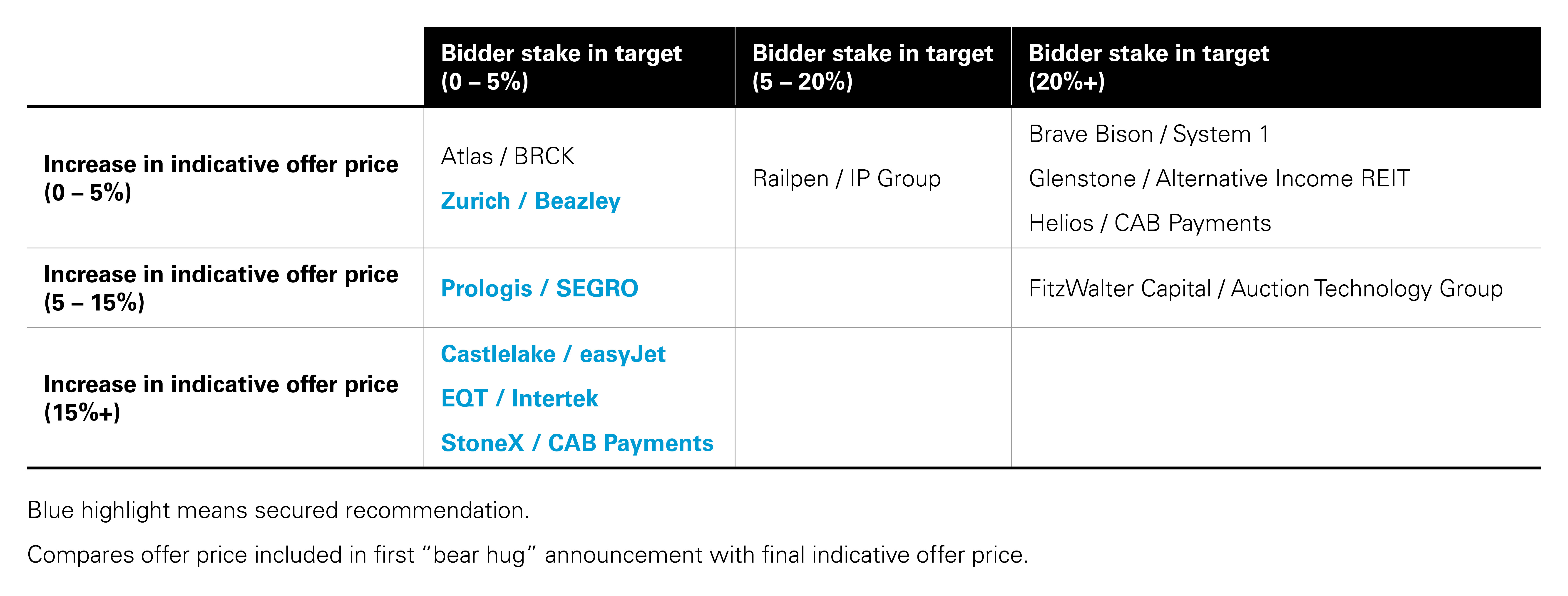
We analyse below the eleven bear hugs between 1 January and 31 July of this year and three distinct patterns emerge from how bidders combine two variables: the size of any stake built up before going public and how far they are willing to move on price once there.
Executive summary
- Bear huggers raised their offer price by a median of 18.5 per cent. between the initial bear hug announcement and the final price that secured the target board's recommendation, compared with a median increase of ~10 per cent across all approaches that resulted in a firm offer in recent years.
- Price, just as in privately negotiated takeovers, determines the outcome: only a meaningful increase turns a bear hug into a recommended deal.
- A blocking stake gave bidders the confidence to go hostile, but none of the three hostile bids in the sample has yet produced a successfully completed takeover.
Various explanations for the surge in these bear hug approaches have been advanced to provide a rationale for why they are becoming more common. They identify three structural forces behind that shift. Firstly, the UK market has lost the domestic, long-term investors who would once have rallied behind a board's own valuation. Bidders can now challenge the assumption that the register will fall in behind the target board's recommendation. Secondly, that changing investor base is not just more receptive, but more vocal, increasingly willing to say privately and publicly that a board ought to engage. Finally, many UK-listed companies have also traded at a sustained discount to international peers, so target shareholders may prefer a premium in hand over a board's multi-year case for a higher standalone valuation.
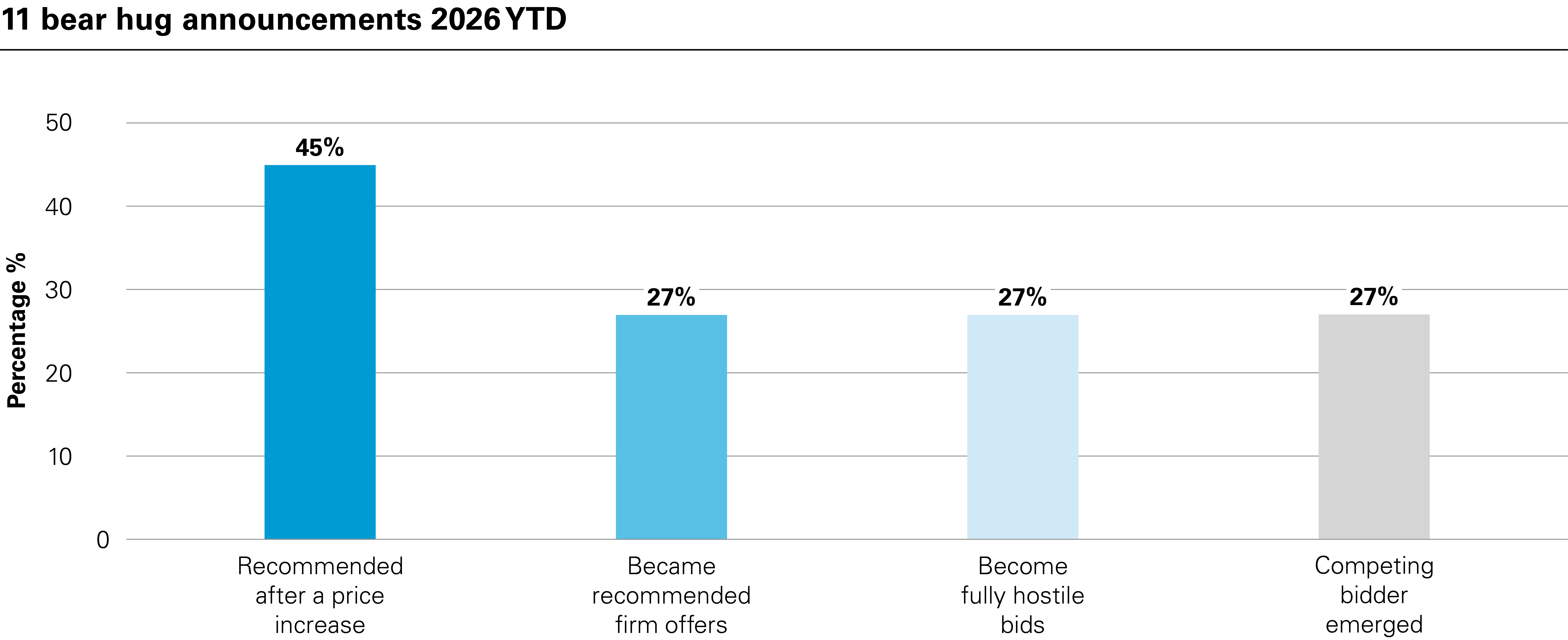
Pattern one: no meaningful stake, a real price increase — recommendation
The clearest pattern in the sample is also the simplest: a bidder that holds no meaningful stake in its target and is willing to move materially on price tends to secure a recommendation.
On each of Prologis/SEGRO, EQT/Intertek, Zurich Insurance/Beazley, Castlelake/easyJet and StoneX/CAB Payments, roughly half of the sample, the bidder eventually won a board's blessing after improving its price, and three of those have developed into firm recommended offers. The easyJet board subsequently switched its recommendation to Apollo, and StoneX withdrew its offer because of a lack of support from Helios.
Each of these deals required a price increase before the board would recommend it and the median increase between the offer price in the initial bear hug announcement and the ultimately recommended offer price was 18.5 per cent.
Case study
Castlelake's pursuit of easyJet is the clearest illustration, with the bidder raising its offer four times before winning a recommendation, only for the target to pivot to recommend a superior counter-bid from Apollo once it had endorsed a price.
Bidders without a meaningful stake had to earn support through price alone, which may explain why they moved further than others. Investment bank analysis of recent public takeovers puts the median increase between first and last prices offered (publicly or privately) at more than 10 per cent across all public takeovers, making the 18.5 per cent median move in these bear hugs notably larger. This is also consistent with the data in 2024, where thirteen of seventeen bear hugs involved a price increase, with a median uplift of 12.9 per cent. where there was movement.
Whether the public nature of the bear hug drove that larger increase, or whether these bidders would have paid more in a private negotiation, is hard to untangle; the type of bidder and board involved may matter as much as the pressure of a public bear hug.
The contrast with the transactions considered below, where price stayed largely static, makes the point clearly: a meaningful price increase separates a bear hug that wins a recommendation from one that does not. Price determines the outcome, just as it does in privately negotiated takeovers.
Pattern two: a substantial stake, little or no price movement — hostile and unresolved
The second pattern involves a substantial pre-existing stake with a bidder unwilling or unable to move meaningfully on price.
Three of the eleven bear hugs developed into hostile bids: Helios/CAB Payments, Glenstone REIT/Alternative Income REIT and Brave Bison/System1 Group. Each of these bidders already controlled between 25 and 50 per cent. of the target's shares before going public, yet, unlike the bidders discussed above, held its price steady or nudged it only fractionally.
That combination of a blocking-sized stake and minimal price increase suggests an inability or unwillingness to bridge the gap between the bidder's offer and the board's view of value. A stake of that size gives a bidder confidence to press ahead without the board's cooperation, since it can block any competing proposal (as the Helios consortium did to StoneX).
All three of these transactions remain unresolved: none has yet produced a recommendation or a successfully completed hostile takeover. A substantial pre-existing stake gives a bidder real leverage, but it does not guarantee a successful outcome.
Stakebuilding
Stakebuilding is on the rise with some high-profile examples in the last twelve months (eg Brookfield / Just Group and Blackstone / Warehouse REIT). After many years of minimal pre-bid stakebuilding and the predominance of schemes of arrangement, the last few years have seen a sharp increase in tactical stakebuilding and the use of contractual offers instead of schemes.
Pattern three: no blocking stake, an indecisive approach to price — withdrawn
The third pattern is the hardest to characterise, which may be the point: these bidders did not commit clearly to either of the other two approaches.
Railpen/IP Group, FitzWalter Capital/Auction Technology Group and Atlas/BRCK all did not proceed to firm offers, with each bidder withdrawing before its original or extended "put up or shut up" deadline. The Code's "put up or shut up regime" (introduced after the 2010 Kraft/Cadbury takeover) does not prevent a bidder from launching a bear hug; it simply forces the bidder either to make a firm offer or walk away within 28 days unless the target board agrees to an extension.
Railpen and FitzWalter Capital each held around 20 per cent. of their respective targets, more than the bidders with no stake, but short of the 25–50 per cent. range that gave the hostile bidders the confidence to press ahead alone. On price, neither bidder committed to the sustained uplifts that characterised the recommended deals, nor did they hold firm in the way the hostile bidders did; their behaviour was mixed rather than decisive. All three withdrew before the applicable deadline. A blocking stake buys leverage and staying power, but without a clear commitment on price it did not produce a result. This middle ground looks less like a deliberate strategy than a tentative approach that never resolved into one.
Standstills, NDAs and inside information
A bear hug bidder can only go public if it is free to do so. Most well-advised targets will insist on a standstill provision in any NDA agreed with a potential bidder. A typical standstill prevents the bidder from making public announcements (unless required by law) and from building a stake in the target. A bidder that has signed an NDA containing a standstill cannot launch a bear hug while that standstill remains in force.
It follows that each of the bear hug announcements in this sample must have been made either before the bidder entered into any NDA with the target or after the standstill had expired or fallen away. For the same reason, a bear hug bidder is very unlikely to be in receipt of inside information about the target at the time of its public announcement, since the target will not have shared any such information outside the protection of an NDA and standstill.
Conclusion
The eleven bear hugs examined here cluster around three distinct patterns, each defined by two variables: the size of the bidder's existing stake and its willingness to move on price. Bidders with no stake that raised their price significantly tended to secure a recommendation. Bidders with a blocking stake that held firm on price pushed into hostile territory but have yet to reach a resolution. Bidders that fell between the two, a modest stake and no clear commitment on price, withdrew before their deadlines expired.
Going public with a bear hug announcement does not by itself determine an offer's fate. What matters is the combination of tactics a bidder deploys once it has taken that step: how much of the register it controls and how far it is prepared to move on price. With four months of 2026 still to run, this year's wave of bear hugs shows no sign of slowing.
White & Case means the international legal practice comprising White & Case LLP, a New York State registered limited liability partnership, White & Case LLP, a limited liability partnership incorporated under English law and all other affiliated partnerships, companies and entities.
This article is prepared for the general information of interested persons. It is not, and does not attempt to be, comprehensive in nature. Due to the general nature of its content, it should not be regarded as legal advice.
© 2026 White & Case LLP


