
White & Case defense technology sector report
Market perspective

We are at a pivotal point in the development of new defense technologies and their scaling to meet the requirements of the current geopolitical environment. Private investment in innovation and developing agile and resilient supply chains is vital to the success of the UK defense technology sector as well as national interests. Our survey confirms that the UK is clearly the leading European market for global defense technology investment, as virtually all (97 percent) surveyed businesses in this market are racing to raise and deploy significant new capital. We are actively supporting this growth by aligning investors and the companies that need their capital in one of the most dynamic and fast-developing markets.
Executive summary
The UK defense technology sector is in the middle of a boom, seeing high sustained investment levels and consolidation. Confidence among senior decision-makers is strong, and capital is flowing from government, private capital and strategic investors alike.
Defense businesses are needing to scale faster than organic growth alone allows, to develop products, get to market and deliver for their customers at sufficient scale. Across the ecosystem, defense technology companies are turning to M&A, joint ventures, IP licensing transactions and strategic partnerships, among other growth strategies, to scale faster and faster.
Despite the optimism apparent in the UK defense technology sector, serious challenges persist. Procurement speed and regulatory obstacles remain constraints on how quickly that confidence converts into scaled investment, but the optimistic messaging from the industry is clear, and the outlook for growth and development looks more positive than ever.
We surveyed 250 senior decision-makers working across the UK defense and military sectors, from established primes to defense technology start-ups. This report sets out what the data shows across seven sections:
(i) Investment plans and drivers;
(ii) Capital allocation and investment priorities;
(iii) Corporate growth strategies and exit plans;
(iv) Funding and capital requirements;
(v) Supply chains;
(vi) Remaining challenges and the road ahead; and
(vii) Conclusion.
White & Case has been active in supporting the defense technology sector from its genesis, and we remain committed to supporting the industry as these businesses look to accelerate on to their next stage of growth.
Key findings at a glance
of respondents see the UK as the leading European destination for defense technology investment
expect to spend more than £50 million in capital expenditure and investment over the next 12 months
of respondents are pursuing strategic partnerships as their primary growth strategy
of respondents see a private equity sale as their most likely exit
of respondents plan to raise significant external funding in the next 12 months
Background and methodology
The UK defense sector is undergoing a structural shift. The UK Government’s Defence Investment Plan, published on June 30, 2026, commits £298 billion of investment over the next four years in support of the Strategic Defence Review’s vision for the future Armed Forces,1 including £11 billion earmarked for novel technologies such as AI and autonomous and uncrewed systems. That commitment reflects a broader recalibration: Defense has moved from a low-growth procurement-heavy sector to one defined by technology investment, platform innovation and intensifying competition for capability.
The UK and its NATO allies have committed to spend at least 3.5 percent of GDP on core defense by 2035 as part of a broader 5 percent target encompassing defense and security-related spending.2 At the same time, governments across Europe are seeking to strengthen domestic supply chains, boost industrial resilience and accelerate the procurement of next-generation capabilities. The scale of public spending has, in turn, drawn significant private capital into the sector, with financial sponsors, venture capital investors, sovereign wealth funds, corporate venture vehicles and strategic acquirers competing for access to the technologies and businesses best positioned to succeed.
It is against this backdrop—rising public budgets, faster-growing private capital flows and an increasingly competitive market for defense technology assets—that White & Case commissioned this survey of senior decision-makers in order to understand how the industry is responding and where it expects to go next.
Censuswide carried out the survey of 250 senior decision-makers3 working across the UK defense and military sector, including UK-headquartered prime contractors, industrial suppliers and technology companies in the defense supply chain; UK-headquartered defense technology start-ups; and international defense and industrial companies operating in the UK. Fieldwork was conducted between September 17 and 24, 2026. Censuswide abides by and employs members of the Market Research Society, which is based on the ESOMAR principles.
Most figures in this report are based on the full sample of 250 respondents. Where a question was only put to a relevant subset of respondents (for example, only those who indicated an intention to invest in next-generation defense technology, or only those targeting a particular type of funding), the figure is based on that filtered subgroup, and the applicable base size (n=) is stated in the figure label.
Report
1. Investment plans and drivers
Market perspective


The defining feature of this market right now is the intensity of competition. It's competitiveness — not government spending — that's driving investment decisions, and that tells you how quickly the sector has matured. Businesses aren't just responding to bigger defense budgets, they're racing each other for position. The capex commitments are substantial, and the pressure to move quickly on the right R&D, talent hires, acquisition, JV or partnership is only going to intensify over the next 12 months. For the businesses that get their growth strategy right now, the rewards will be significant.
Confidence in the UK’s outlier position as the dominant European defense technology hub is high, with 97 percent of all respondents citing the UK as the leading European destination for technology investment. This confidence is underpinned by a very positive investment outlook.
97% see the UK as the leading European destination for defense technology investment
As UK public defense spending is forecast to rise in order to meet its commitment to spending 3.5 percent of GDP on defense by 2035, defense companies similarly expect to deploy high levels of capital expenditure over the coming years. 94 percent of surveyed companies expect to deploy more than £50 million in capital expenditure and investment over the next 12 months, and 27 percent of surveyed companies expect to deploy more than £100 million. This positive investment outlook holds true across all stages of the growth cycle, with 98 percent of start-ups and early-stage companies surveyed planning capital expenditure and investment of more than £50 million over the next 12 months.
Maintaining competitiveness (50 percent), demand for next-generation technology (42 percent), export opportunities (38 percent) and rising government defense spending (33 percent) are the principal drivers of this investment outlook among surveyed companies, reinforcing the UK’s critical role as a global clearing house for defense technology capital and evidencing that the private sector has responded enthusiastically to public spending signals from the UK government.
2. Capital allocation and investment priorities
Market perspective

The defense technologies attracting the most investment, such as advanced sensors and autonomous platforms, are areas where IP ownership, data rights and licensing structures can be most commercially contested. That complexity is often compounded when the relevant systems integrate AI capabilities. IP rights are therefore increasingly central to defense transactions, particularly on complex projects involving partnerships between national industry champions across multiple allied nations. Further, FDI restrictions in some markets are such that regulatory authorities may not allow a buyer to acquire a company, leaving no option but to enter into IP and technology licensing arrangements instead.
A majority of respondents plan to invest in both traditional defense hardware and next-generation defense technology over the next 12 months, with that investment most commonly aimed at developing new technologies and scaling existing ones.
Given that demand for next-generation technologies is cited as one of the key drivers of planned capital expenditure, it is no surprise that next-generation defense technology is one of the key areas companies reportedly plan to invest in over the next 12 months. 56 percent of surveyed companies intend to invest in next-generation defense technologies over the next 12 months and 57 percent plan to invest in traditional defense hardware. While some companies intend to invest in both next-generation technologies and traditional defense hardware, the data suggests that companies will look to focus on one or the other.
Perhaps surprisingly, while next-generation defense technology remains the focus for start-ups and early-stage companies, with 61 percent of those surveyed intending to invest in next-generation defense technology over the coming 12 months, 46 percent of start-up and early-stage companies surveyed also plan to invest in traditional defense hardware. Among established organizations that were surveyed, investment plans are more balanced as between traditional defense hardware (61 percent) and next-generation technology (56 percent).
Of the 61 percent of respondents who intend to invest in next-generation defense technology over the coming 12 months, cybersecurity, advanced sensors, space technologies and autonomous drones and uncrewed systems are the key areas of focus. The most commonly cited applications for these technologies are air defense, counter-drone and intelligence, surveillance and reconnaissance.
The breadth of these technology priorities, spanning cybersecurity, sensors, space and autonomy, reflects a sector investing across multiple capability layers simultaneously, and that breadth carries real legal complexity. When the asset is a cyber platform deployed across allied networks, or a sensor system integrated into multi-nation programs, questions of IP ownership, data rights and liability allocation cut across jurisdictions in ways that traditional defense procurement rarely demanded. Export control regimes across the UK, US and EU are becoming increasingly granular in response, adding a further layer of structuring complexity for cross-border transactions and licensing arrangements.
Market expansion plans among those surveyed remain firmly UK-led, with 76 percent of respondents targeting the domestic market, followed by Europe (55 percent), the US (27 percent), the Middle East (26 percent) and APAC (26 percent).
3. Corporate growth strategies and exit plans
Market perspective

What is most striking is how closely defense companies are now being built, run, scaled and valued like technology companies. Founders in this space increasingly think and talk like tech entrepreneurs: they are often focused on rapid product iteration and platform scalability rather than the slower, contract-led growth trajectories that used to define the sector. Investors are likely pricing these businesses on tech multiples, not defense-industrial multiples, and that is a real shift in how value is being created and captured. We are seeing founders start defense technology companies with the same ambition and the same playbook as a traditional start-up. That mindset is a big part of why capital is flooding into this sector at the pace it is.
To meet their ambitious growth plans, corporate growth strategies in the defense and defense technology sectors are diverse. While a significant minority of companies surveyed intend to scale organically (42 percent), this sits alongside a range of inorganic options that respondents are pursuing, including scaling through strategic partnerships (44 percent), JVs (40 percent), M&A (38 percent) and IP acquisitions (26 percent).
The most commonly cited driver for these growth strategies is to expand into new markets or customer segments (39 percent), access new technologies (36 percent) and accelerate product development and innovation (35 percent).
This aligns with what we have been seeing, where M&A targets have shifted markedly from a decade ago to include software businesses, AI companies, cyber specialists and space infrastructure providers, and the investor base has similarly diversified. Private equity, sovereign wealth funds, institutional investors and venture capital are now active alongside the strategic buyers and government procurement agencies that once dominated the sector.
Further, the ever-expanding scope of FDI regulation in different jurisdictions can render acquisition-based growth strategies difficult to achieve, requiring a differential market-by-market growth strategy. The data speaks to what we have been seeing: Companies are increasingly adopting bespoke multi-pronged growth strategies that may require M&A in market A, strategic partnerships in market B and IP in-licensing in market C. It’s no surprise that the data reflects this complexity, because there is no one-size-fits-all solution.
Market perspective

The dominance of a sale to private equity as the expected exit route has real implications for primes and mature defense companies and their boards, which will be facing unprecedented competition in upcoming sale processes. This expectation is matched by appetite on the sponsor side, where we are already seeing intense competition and more typical control investors taking minority stakes in funding rounds to establish positions ahead of anticipated exits.
71% see a private equity sale as their most likely exit route
The overwhelming majority of surveyed companies (98 percent) are considering some kind of exit within the next five years, with a sale to private equity being the commonly cited exit strategy (71 percent). Surprisingly, only 5 percent respondents reported a trade sale as being their most likely exit option, whereas 22 percent consider an IPO to be their most likely exit option.
While we might have expected to see greater reported interest in trade exits, the data does reinforce the trend that we have been seeing on the ground of private capital, showing rapidly increased interest in the defense technology sector as compared with, say, five years ago. It follows that defense technology companies are feeling the support of private capital and now see it as overwhelmingly the most viable exit route.
Whereas historically the investment thesis or acquisition rationale for trade buyers and corporate venturers was primarily integration-driven, that’s to say they made operational and business sense—as the defense sector has collided with the technology sector, these companies are increasingly attractive financial propositions to a broader panel of acquiror profiles.
4. Funding and capital requirements
Market perspective

The capital base for UK defense technology remains heavily domestic, but the cross-border picture is evolving quickly, and European, Middle Eastern, APAC and US investors are increasingly paying a lot of attention. For businesses navigating those flows, the regulatory environment is now the single most important factor shaping fundraising decisions. Getting the foreign investment screening and approvals piece right early in the process—before term sheets are signed—is becoming as important to a successful raise as the commercial terms themselves. The businesses that build regulatory readiness into their fundraising strategy from the outset will move faster and attract better terms.
Scaling defense technology companies is expensive business and burn rates tend to be very high, as companies may be required to rapidly develop products or scale production in order to deliver on their contractual commitments to governments and other customers, for example. It is no surprise that almost all of the surveyed companies (97 percent) reported that they were likely to raise “significant” external funding over the next 12 months in order to accelerate growth. Not a single start-up or early-stage company we spoke to said they were not likely to raise funds.
Companies look to be considering blended finance solutions, with 49 percent of respondents looking to raise equity finance in the next 12 months, 47 percent looking to raise debt finance and 39 percent looking to make use of government grants. The combination of a mature VC ecosystem, ready access to global money markets and a supportive government makes the UK a fantastic place for any capital needs, so we are not surprised to see companies intending to make use of the various capital sources on offer.
Interestingly, government-backed investors are seen as the most attractive source of equity finance, narrowly followed by corporate venture investors, strategic corporate investors and private equity firms. There are various reasons that this might be, but it may be that this profile of investor is better placed to integrate defense technology products with their existing investments or product ranges, unlocking greater growth potential than conventional venture capital investors or family offices, for instance.
For private and venture capital, defense technology now represents a compelling investment proposition with growing government budgets, long-term contract visibility, recurring revenues, high barriers to entry and demand patterns partly independent of broader economic cyclical trends. Further, the hesitancy that once caused some funds to avoid the sector has softened, and the positive social externalities of defense technology with dual-use applications have come more sharply into focus.
There is an interesting dynamic borne through the data however, that while defense technology companies appear very favorably disposed to taking on growth investment from corporate venture investors and strategic corporate investors, when it comes to considering their preferred exit route, private equity remains the most alluring.
Favored debt solutions are similarly varied, with companies reporting a preference for blended financing through a combination of convertible debt, venture debt, commercial paper, direct lending, banks and government-backed lending schemes.
UK and European investors remain the predominant sources of capital for these companies, with the number of businesses expecting investment from UK sources alone outstripping investment from APAC, the US and the Middle East combined. That said, we are seeing a marked increase in interest among overseas investors from the UK's strategic partners, and it is increasingly common to see them represented in funding rounds.
97% plan to raise significant external funding in the next 12 months
5. Supply chains
A majority of surveyed businesses have increased their reliance on UK and European suppliers over the past three years, and almost all (92 percent) surveyed businesses plan to work with more UK suppliers in the next 12 months. Defense technology companies are clearly growing in symbiosis with the ecosystem that supports them, including with their suppliers as the broader UK defense technology sector matures.
This bodes well for the outlook of the UK’s defense technology sector, with the sourcing of key critical supplies from within the same market giving the sector encouraging domestic resilience to economic and geopolitical turbulence.
6. Remaining challenges and the road ahead
83% see the regulatory environment for defense businesses in the UK and across the EU as supportive
The outlook, clearly, is positive. Investment plans are bullish and UK defense technology businesses are fully feeling the buy-in and support from the UK government toward the sector. Indeed, 83 percent of businesses surveyed described the current regulatory environment for defense businesses in the UK and across the EU as being “supportive.”
However, the industry is not without its challenges, which are compound. While challenges around procurement regulation tops the list of reported challenges among respondents (32 percent), regulatory challenges of all kinds including national security regulation, FDI screening, merger control restrictions and export control restrictions remain pain points for defense technology businesses in scaling.
Looking deeper into the challenges facing the industry regarding UK and European procurement regulation specifically, frustrations of surveyed businesses cluster around:
- Requirements or specifications changing after contracts have been awarded (38%)
- Procurement processes favouring established suppliers over newer market entrants (36%)
- Uncertainty over future procurement opportunities and demand visibility (32%)
- Lengthy procurement processes and extended decision-making timelines (30%)
It is therefore no surprise that when asked what actions UK and European governments could take to better support the development of world-class defense technology businesses and enable companies to invest and scale, the most popular responses clustered around reforms to procurement processes, to make them more transparent, clear and accessible. This is a commonly reported pain point for the sector and industry commentators have called for reform in this area, so it is affirming to see the importance of this once again borne out in the data.
7. Conclusion
Taken together, the results of our survey tell a positive story, which remains remarkably consistent across the types and sizes of businesses surveyed: UK defense technology businesses feel well supported by government and they are confident, ambitious, well capitalized and actively pursuing growth through acquisitions, partnerships and external funding, while continuing to invest directly in next-generation capability. Investors are converging on the sector from multiple directions, and the capital outlook looks positive.
The next-generation technologies that are expected to attract the greatest capital expenditure (autonomy, cyber, space technologies and advanced sensors) could prove to be significant value drivers for the UK economy and will carry positive broader social externalities through dual-use applications, yet these are also intensely IP-rich technologies where ownership and protection of the underlying IP will be critical to businesses going forward—it will be vital to ensure it is well protected as companies scale.
The principal remaining constraint on growth is reportedly the pace and predictability of government procurement and the obstacles with the wider international regulatory environment. Any steps by the UK government to encourage even greater certainty and transparency in its procurement processes would be met with enthusiasm by the sector.
The direction of travel over the next 12 to 24 months looks set to be one of continued growth and investment, with the survey data showing no signs that the white-hot defense technology M&A market that we have been experiencing will cool down.
White & Case in defense technology
The defense technology sector sits at the intersection of government, technology and private capital. So do we.
White & Case advises businesses, investors, lenders and governments across this ecosystem on the transactions, financing arrangements, regulatory frameworks and strategic partnerships that are shaping the sector’s next phase of growth. Our team combines deep industry knowledge with market-leading M&A, private capital, IP and technology, national security, foreign investment screening, export controls and disputes capabilities.
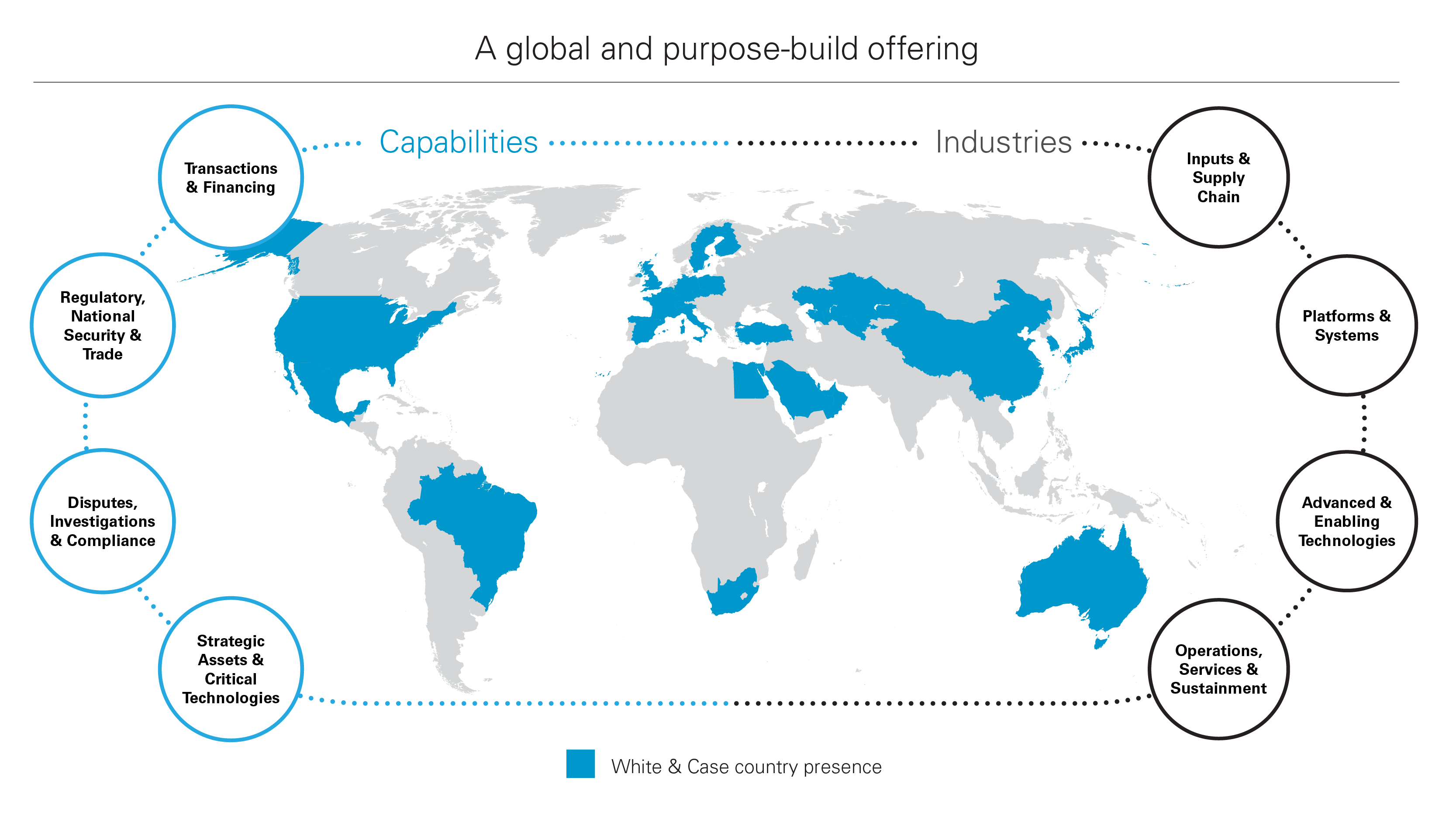
With lawyers across the UK, Europe, the US, the Middle East and Asia-Pacific, we advise on matters ranging from growth capital financings and strategic acquisitions to complex cross-border national security reviews, defense procurement arrangements, joint ventures and technology licensing. The themes explored in this report—capital deployment, M&A-led growth strategies, evolving funding structures and regulatory navigation—are at the center of our practice.
A global and purpose-build offering
Select experience
- Advising lead investors on financing rounds for Helsing, the defense technology company developing AI-driven autonomous systems and defense hardware.
- Advising lead investors on multiple growth financing rounds for Quantum Systems, including its US$1.2 billion Series D financing.
- Advising QIA on its participation in the €1 billion Series F funding round of geospatial intelligence company ICEYE.
- Advising Lightrock as lead investor in Open Cosmos, as part of a €300 million financing round.
- Advising the syndicate banks in connection with the contemplated IPO of KNDS, the German-French defense group.
- Advising on the sale of VINCORION, the military technology division of Jenoptik, to a fund managed by Star Capital.
- Advising Avon Rubber on a series of defense-related acquisitions and disposals, including international acquisitions in the US.
- Advising Advanced Protection Systems on contracts relating to Project SAN, Europe’s largest anti-drone system.
- Advising Hanwha Aerospace, Lockheed Martin, Korea Aerospace Industries (KAI), Airbus, Safran and other leading defense and aerospace companies on major defense procurement, offset and strategic industrial programs.
- Advising GSO Capital Partners and its affiliates on Advent International’s approximately £4 billion acquisition of Cobham plc, a leading UK defense technology company, including national security and foreign investment considerations.
- Advising Carlyle on its restructuring and minority buy-out of the Rausnitz family's minority stake in Meopta, a global technology and manufacturing company supplying advanced optical, opto-mechanical and optoelectronic systems for defense, aerospace and other sectors.
- Advising ISTARI Global, the cyber resilience platform of Temasek, on strategic investment and cross-border growth capital transactions in the cybersecurity sector.
1 HM Government, Defence Investment Plan (30 June 2026); Strategic Defence Review 2025 (2 June 2025).
2 NATO, The Hague Summit Declaration (25 June 2025).
3 Senior decision-makers includes C-suite roles, commercial directors, finance directors, general counsels, heads of M&A, managing directors, operations directors, strategy directors and other director-level roles.
White & Case means the international legal practice comprising White & Case LLP, a New York State registered limited liability partnership, White & Case LLP, a limited liability partnership incorporated under English law and all other affiliated partnerships, companies and entities.
This article is prepared for the general information of interested persons. It is not, and does not attempt to be, comprehensive in nature. Due to the general nature of its content, it should not be regarded as legal advice.
© 2026 White & Case LLP


