

Resilient but multi-speed market.
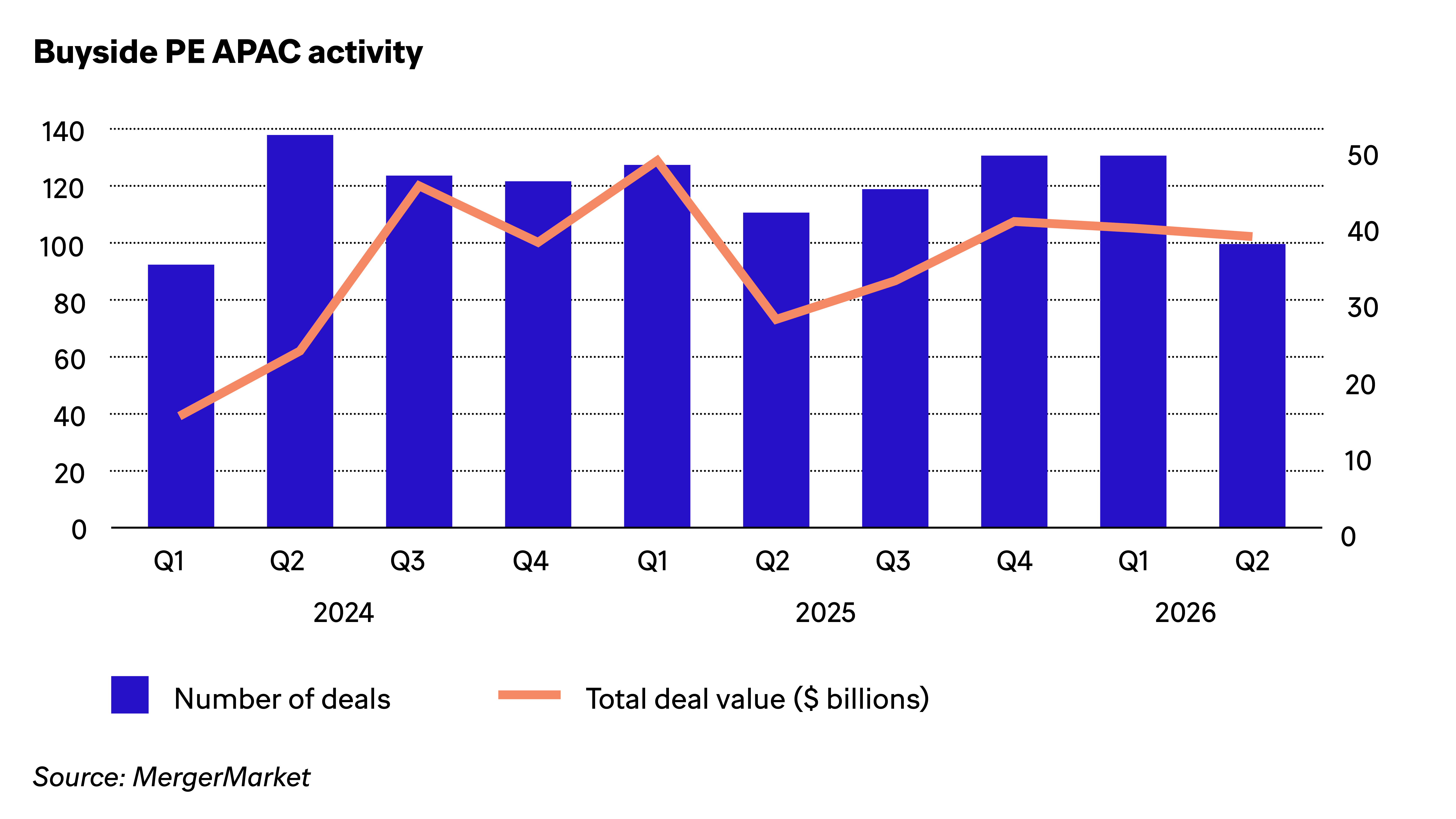
Q2 2026 activity across APAC tells a story of divergence across sectors and markets. Despite geopolitical events and macro turbulence, at the top line, dealmaking held up across APAC year on year, fuelled by some multibillion-dollar deals.
But dig beneath the regional numbers, and there are a few select sectors, geographies and trends driving the headline activity levels.
- Japan and India surge as other markets hold
- Sector focus
- High contrast picture for liquidity and fundraising
- Strong liquidity and fundraising shows underlying market confidence
- Inbound vs. outbound: Comparing H1 2025 and H1 2026
- Key APAC regulatory developments
- Jurisdiction spotlight – Japan
Japan and India surge as other markets hold
- Japan’s M&A deal flow continues to surge underpinned by ongoing structural change, whilst India’s strong growth has continued to be fuelled by domestic growth, consumer markets and public market activity.
- Meanwhile, other markets in the region have managed to hold steady overall, with the overall economic picture benefitting from sector-specific deals in high-growth sectors which mask inflationary pressures and other macro impacts on other sectors.
Sector focus
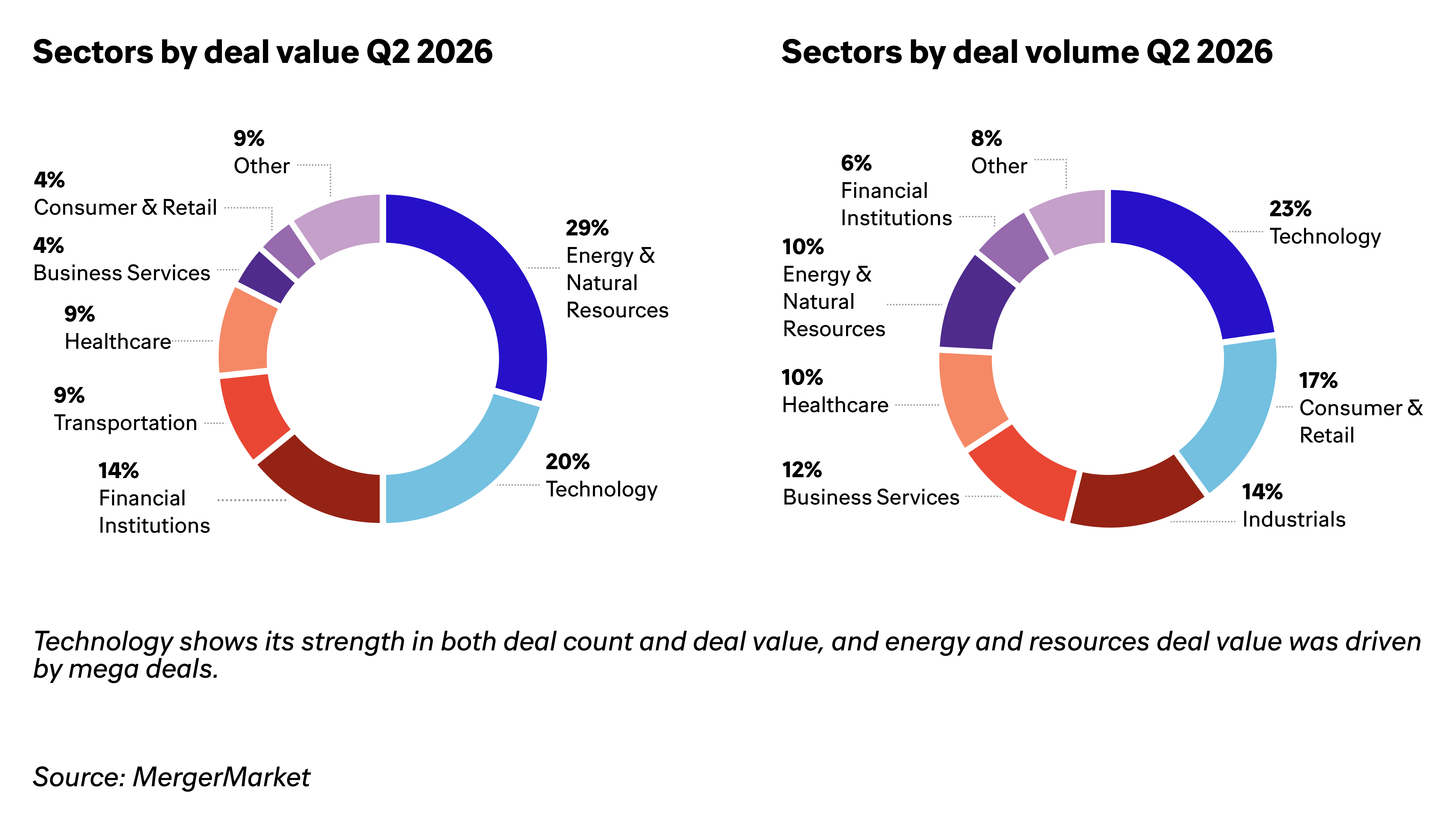
- Across APAC, M&A activity has unsurprisingly been heavily concentrated in the AI and energy transition driven sectors.
- Compared to prior years when the AI boom was already well underway, deal activity has concentrated disproportionately around the interconnected AI infrastructure ecosystem: data centres, adjacent digital technology and power-related infrastructure, including a growing focus on enabling infrastructure such as for grid stability and management.
- GPs are competing fiercely for assets in these sectors, with sector expertise and experience proving crucial to successful dealmaking at speed when quality assets come to market.
High contrast picture for liquidity and fundraising
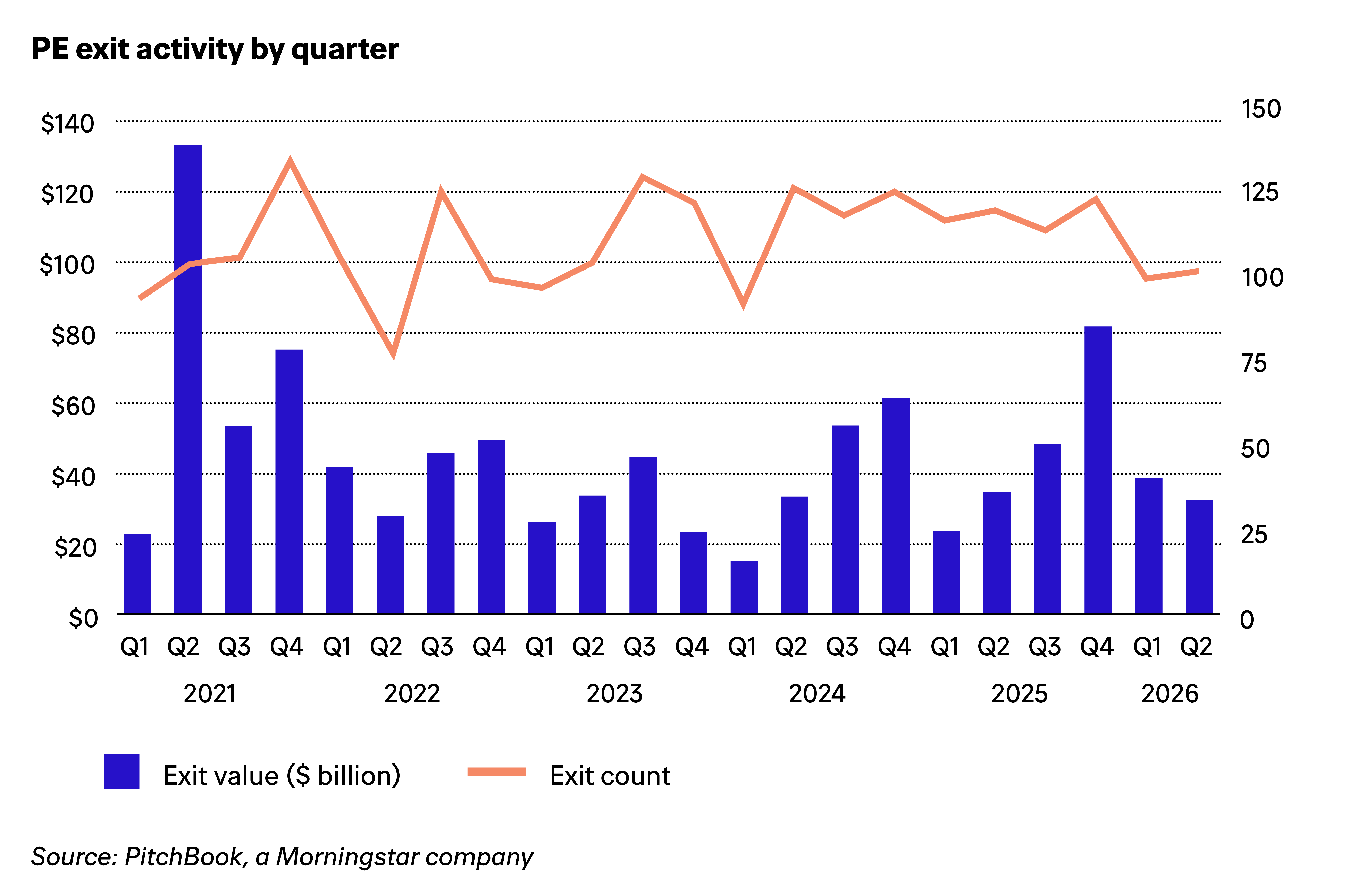
- Bain’s Southeast Asia Private Equity Report 2026 found that SEA exit value actually declined 32% in 2025 to approximately US$4 billion, with trade sales remaining the dominant exit route and IPO activity showing only early signs of recovery.
- However, median exit timelines continued to lengthen, indicative of Sponsors holding back assets or deciding not to sell in the face of uncertainty from all sides (political, macroeconomic, inflationary, interest rates, AI valuation impacts) and persistent valuation misalignments between buyers and sellers.
- Our take on the apparently conflicting data, is that there is a selective exit environment. Sophisticated GPs, with quality assets, who are adopting alternative liquidity strategies are succeeding. The data also reflects the realisation of assets which Sponsors simply cannot continue to hold.
- Bain also reports that net distributions turned positive after three years of net outflows, offering partial relief to LP liquidity pressures.
- Fundraising is also becoming more selective. LPs are favouring larger GPs with specialised strategies which focus on strong asset classes and demonstrate a clearer pathway to ultimate asset realisation and LP returns.
Strong liquidity and fundraising shows underlying market confidence
- SEA exits rebounded in Q2 2026 to a total of US$4.2 billion – the strongest since early 2022 – even as median exit timelines continued to lengthen, according to the EY-Parthenon Southeast Asia Private Equity Pulse (Q2 2026).
- The improvement in liquidity was also driven by a selective exit environment which heavily favoured very large companies in competitive sectors and a continued trend of sophisticated GPs adopting alternative liquidity strategies, such as capital recycling.
- The improvement in liquidity and realisation has also underpinned improvements in fundraising conditions. But selectivity is again a thematic with LP willingness to fund focused on the larger GPs with specialised and demonstrated strategies which give a clearer pathway to ultimate realisation (often also in those sectors benefitting from industry tailwinds).
Inbound vs. outbound: Comparing H1 2025 and H1 2026
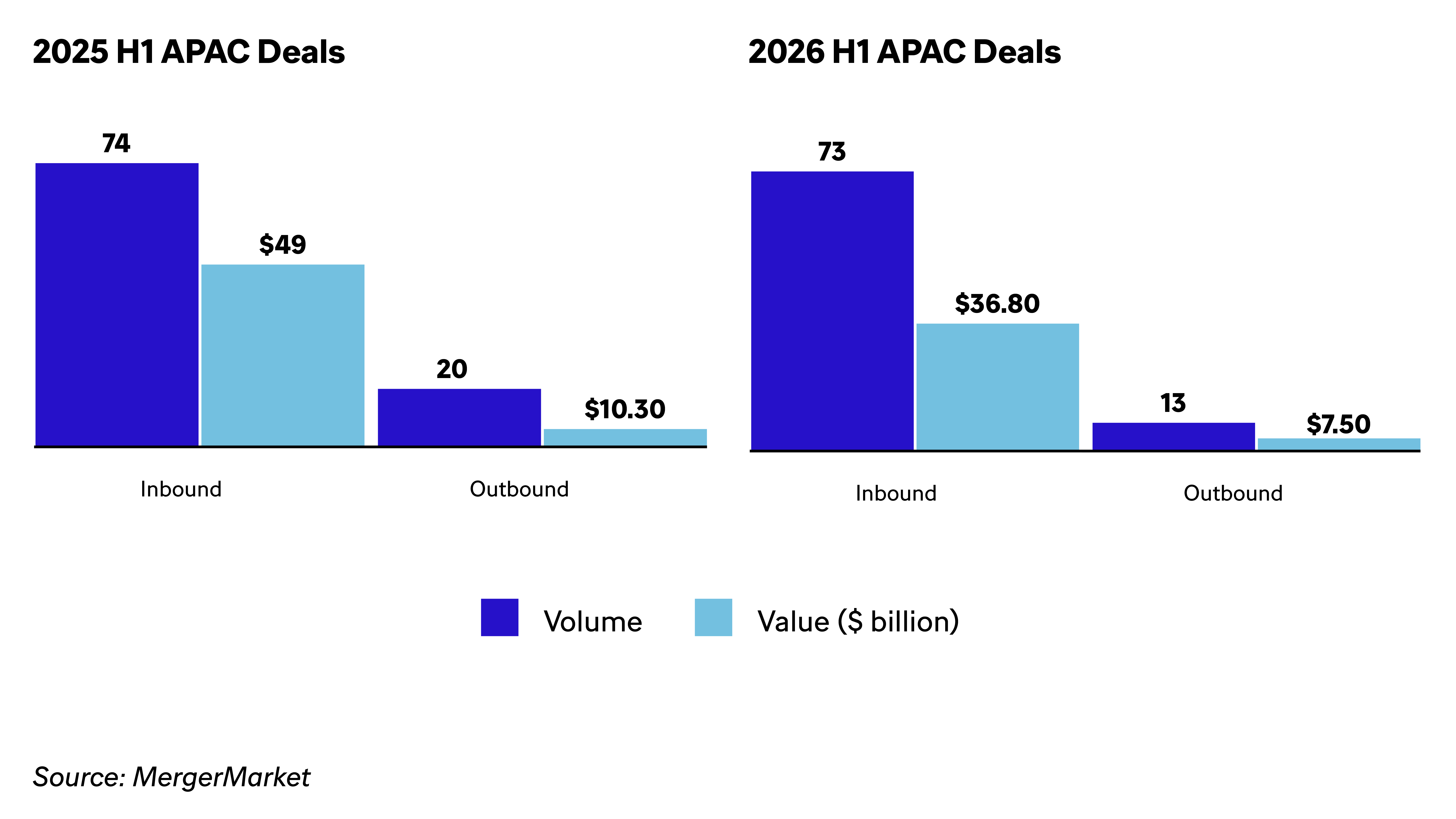
H1 2025 vs H1 2026 analysis shows much more than year on year deal flow changes – APAC outbound capital has been far more reduced than inbound capital by macroeconomic and political instability and mega deals are the scaffolding holding up inbound deal value.
Key APAC regulatory developments
- Australian Foreign Investment: Reforms to Australia’s foreign investment regime are expected to introduce a new exemption-certificate power for certain investors (including for those with passive foreign government investor status), a 30-day decision target for low-risk deals with higher screening thresholds, and recalibrated control/influence tests alongside stronger disposal and prohibition powers. Read more here.
- New Australian substantial holder rules to impact on equity derivatives’ disclosures and pre-bid stakes: A new Australian substantial holding notice regime will be introduced later this year, requiring detailed disclosure of short and long positions in equity derivatives.
- Japan’s foreign direct investment reforms: Japan’s Cabinet Office has approved a bill to amend the Foreign Exchange and Foreign Trade Act, following advisory opinion drafted by the Council on Customs, Tariff, Foreign Exchange and Other Transactions on the new structure for Japan’s foreign direct investment review regime. Read more here.
- Australian capital gains tax changes: Following the 2026 Federal Budget announcement of sweeping changes to Australia’s capital gains tax regime, the Australian Federal Government continues to refine its proposals. Read more here.
- NSW, Australia data centre framework: The NSW government has introduced a new data centre policy framework to provide fast-tracked planning approvals in certain circumstances.
Jurisdiction spotlight – Japan
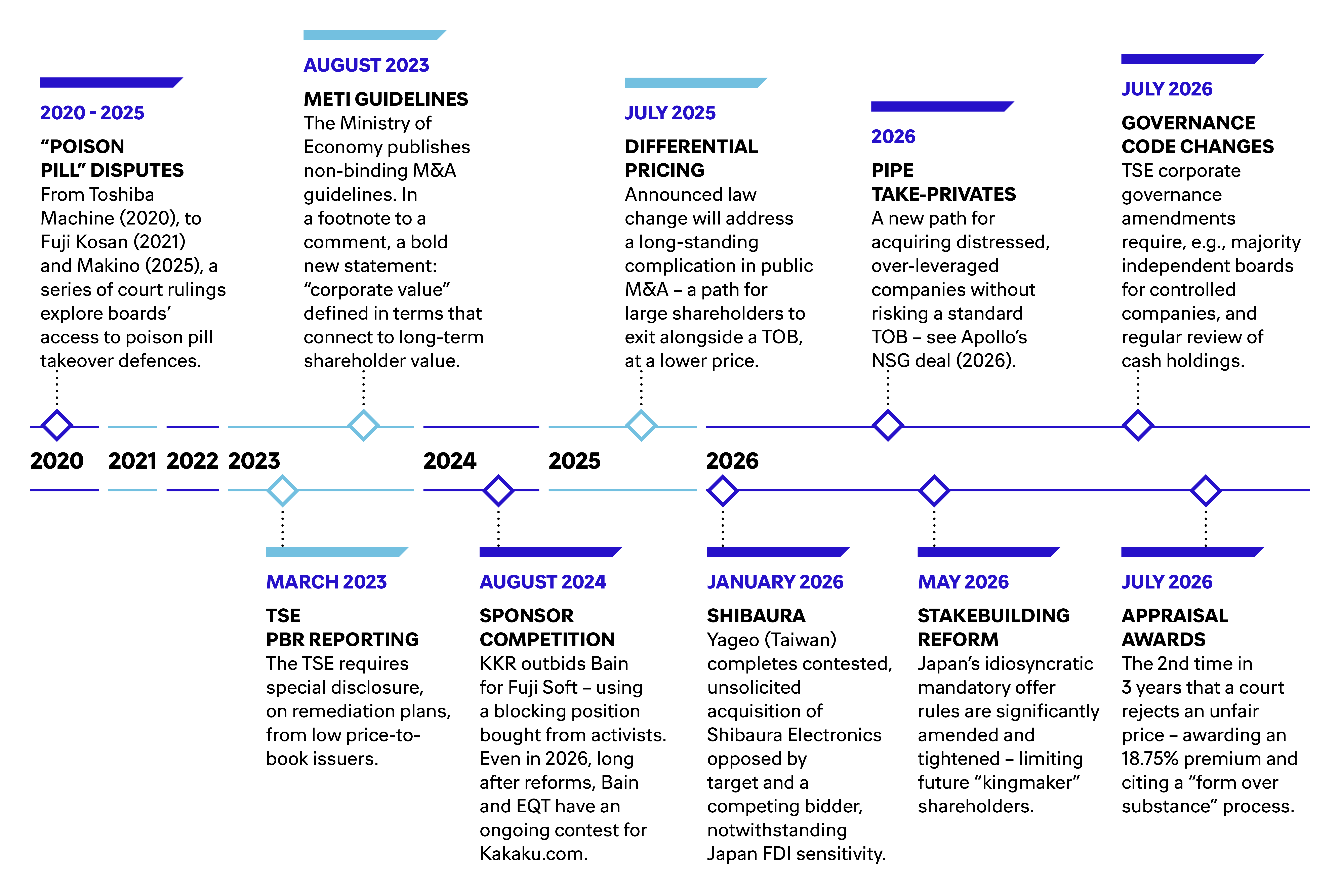
How we got here and where we are going: New opportunities for Private Capital are flowing directly from the rapidly developing legal environment.
It is an exciting time to be working in the Japanese M&A market. Not just because of deal volume - because of the rapid pace of legal change. We are creating new chapters of takeover law in real time to get our clients the successful outcomes they want and capitalise on opportunities. What is possible now is miles beyond what was possible even two years ago.Partner | Tokyo

Hothouse evolution in Japan
The Japanese market of 2026 has been defined by explosive change and growth – with public takeovers making up the bulk of M&A activity. The players, legal norms and deal structures of today would have been hard to imagine just a few years ago. The active and changing environment has driven rapid shifts – not only in how we do deals, but also in what deals can be done.
Recent White & Case deals – Japan spotlight
Recent deals (where our legal experts have been at the forefront) highlight how these market and legal developments are translating into outcomes for private capital and the sponsors and funds we represent:
- Yamauchi-No. 10’s multi-year investment in TSE-listed Toyo Construction reached a successful conclusion in 2025. Beginning with stakebuilding into an (undervalued) offer, followed by an unsolicited counterbid and proxy fight to defeat a poison pill, Yamauchi-No.10 then proceeded to replace a majority of the board by shareholder proposal, ultimately culminating in a trade sale for approximately JPY 160 billion;
- In 2025, EQT successfully negotiated take-private terms with the special committee of Fujitec, the leading TSE-listed elevator OEM, following entry into tender and support agreements with existing shareholders Oasis and Farallon – White & Case represented EQT;
- Bain’s take-private of MCJ (owner of the leading Japanese PC brand, Mouse Computer) succeeded despite activist shareholder objections to the process;
- A Singapore-based family office in its topping bid and contest with Hakuhodo DY Holdings, a Japanese strategic, for control of TSE-listed leading digital marketing company Digital Holdings; and
- In early 2026, Apollo Global Management agreed to acquire Japanese glass manufacturer Nippon Sheet Glass in a take-private deal valued at approximately US$3.7 billion.
This document includes data derived from data provided under license by ION. ION retains and reserves all rights in such data.
White & Case means the international legal practice comprising White & Case LLP, a New York State registered limited liability partnership, White & Case LLP, a limited liability partnership incorporated under English law and all other affiliated partnerships, companies and entities.
This article is prepared for the general information of interested persons. It is not, and does not attempt to be, comprehensive in nature. Due to the general nature of its content, it should not be regarded as legal advice.
© 2026 White & Case LLP


